
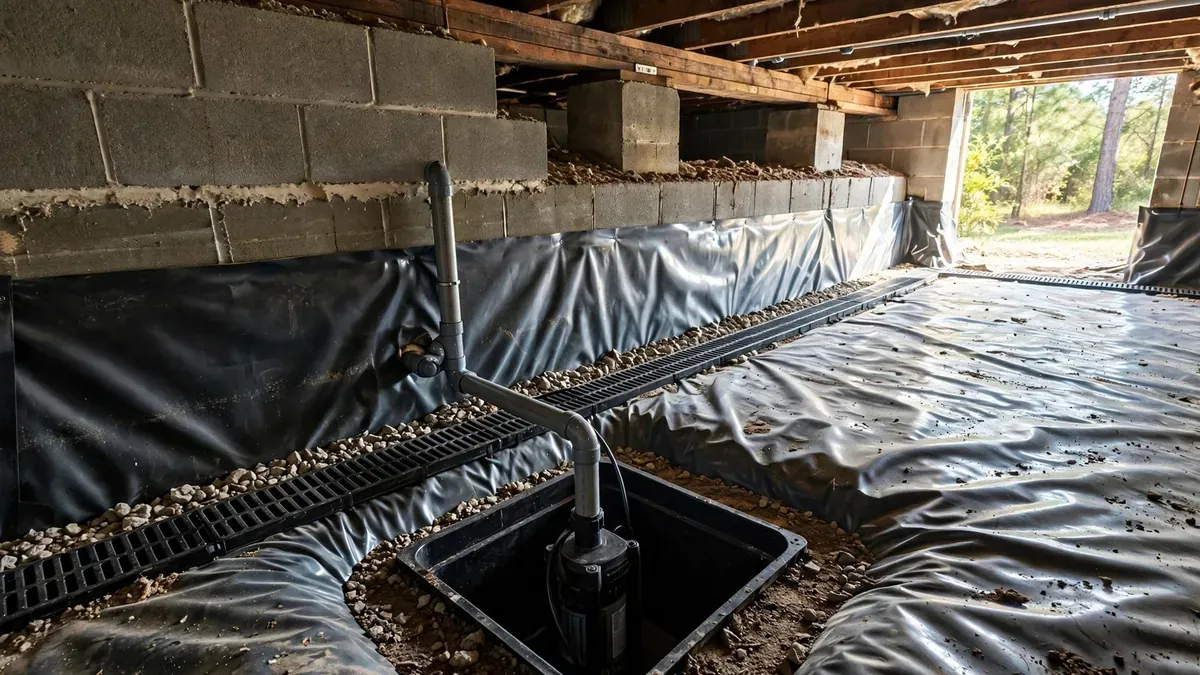
How the membrane system is built
Think of the system as a controlled path for water. The foundation wall will always let some moisture through, so the system gives that moisture a channel to follow instead of a place to pool. Three parts do the work together.
Dimple board
A plastic sheet with raised bumps on one side. Mounted against the wall, the bumps leave an air gap so water slides down the back instead of soaking the wall surface.
Drain channel
A perforated pipe or channel set at the footing along the edge of the floor, under or beside the slab. It collects water from the base of the membrane.
Sump pump
A pump in a lined basin that collects the channel water and pushes it out of the house. Our sump pump installation and repair work covers this part.
The sheet is usually sealed at the top to the wall and at the bottom into the channel, so water has only one way to go. A vapor barrier, a finished wall or insulation can then go over it if you want the basement finished.
When a membrane makes sense
A membrane suits basements where water comes through the wall or leaks at the joint where wall meets floor. It is common for older poured or block foundations with hairline cracks or porous mortar joints. Wet weather brings damp walls, white mineral stains, or small trickles along the base.
Signs a membrane system may help
Check the basement after heavy rain or snowmelt.
- Damp patches or dark streaks on the lower foundation wall.
- White chalky mineral deposits on masonry.
- Water seeping where the floor meets the wall.
- A musty smell that returns after cleaning.
- Peeling paint or bubbling wall finishes.
- Stored boxes or carpet that wick moisture from the floor edge.
We do not diagnose mold or health effects. If you see mold or have health concerns, talk to your doctor and consider a mold specialist. Our job is the water path: where it comes from, where it goes, and how to move it out.
Where an interior membrane falls short
A membrane is not a cure-all. It does nothing about water pressing on the outside of the foundation, and it does not fix a foundation that is shifting or cracked through. Large, active cracks may need structural repair before any drainage work.
| Problem | Membrane helps? | Better or added fix |
|---|---|---|
| Seepage through wall or mortar joints | Yes | Membrane, channel and sump |
| Water at the floor and wall joint | Yes | Perimeter channel at the footing |
| Roof or yard water pooling by the house | Not directly | Gutters, downspout extensions, regrading |
| Large active crack or bowing wall | No | Structural repair first |
| Sewer or floor drain backup | No | Sewer line work or a backwater valve |
| Rising groundwater through the slab | Partly | Sub-slab drain and a sump |
Before any interior work, fix the easy outside causes. Clean gutters, extend downspouts away from the foundation and make sure the soil slopes away from the house. These steps are cheap and they reduce the amount of water the system has to move.
Water in the basement right now?
If water is coming in, move valuables off the floor and keep power equipment out of standing water. Our 24/7 line is open for basement water problems, and same-day appointments are available when the schedule allows. Shut off electricity to the area only if you can reach the panel dry.
What happens during an installation
Inspect and plan
A plumber looks at where the water enters, checks the wall condition and decides where the sump basin should sit.
Prepare the wall and floor edge
Loose paint or efflorescence is cleaned off. A strip of slab along the wall is opened to place the channel.
Install channel and membrane
The channel goes in with a slight pitch toward the sump. The dimple board is fixed to the wall and sealed into the channel.
Set the sump and test
The basin is set below the slab level, the pump and discharge line are installed, and the slab is patched. Water is poured in to prove the whole path works.
Every basement is different, so a visit comes before a quote. Our basement waterproofing team measures wall length, notes where the water enters and checks where the discharge can legally go.
Where the pumped water must go
Sump water is groundwater. In a home on MDC sewer, it cannot be sent into the sanitary sewer, and a good installer plans the discharge line before digging. The line should end outdoors, away from the foundation, where water can soak in or flow to a storm drain.
- Discharge to the yard, a splash block or a storm drain, never to the sanitary sewer.
- Run the line far enough from the house that water does not flow back to the wall.
- Add a check valve so water does not drain back into the basin.
- Consider a battery backup if power outages come with storms.
- Test the pump with a bucket of water twice a year.
Bloomfield, CT: what MDC customers should know
The MDC sewer ordinance bars storm water, subsoil drainage, seepage into buildings and groundwater from sanitary sewers. In practice that means your interior drain system must pump to the yard or storm drain, not to the house sewer line.
The MDC also runs a Backwater Valve Program that offers a free assessment for homes with wet-weather basement flooding. It can disconnect old backwater valves that let foundation, footing or roof drains discharge to the sewer, and it names a sump pump as the long-term fix. Call 860-278-7850 ext. 3123 to ask about it before you start a project.
Bloomfield's sewer system also takes stormwater through cracked pipes, laterals, downspouts, sump pumps and yard drains, according to the Clean Water Project. A sump discharge sent the wrong way adds to that load.
What drives the cost of a membrane system
No two basements cost the same. These factors set the quote.
Ask your insurer what is covered. The Connecticut Insurance Department says standard homeowners policies exclude flood, sewer backup often needs separate coverage, and flood policies usually have a 30-day wait.
Call (860) 397-8103 and we will give a clear price before work starts.
Questions to ask before you hire
- Where will the sump discharge, and is that legal for my street?
- Is the sump basin sealed and vented properly?
- How is the membrane sealed at the top and at the channel?
- What happens if the power goes out during a storm?
- Is the contractor licensed and insured, and will permits be pulled when required?
We take calls from neighboring towns too. Homeowners in Avon and Simsbury ask the same questions, and the answers depend on the house, not the town line.
Interior waterproofing questions
It is a sheet of dimpled plastic fixed to the foundation wall. It channels water down behind it into a drain at the floor edge, which leads to a sump pump.
No. It manages water after it comes through the wall and sends it out of the basement. Outside fixes like gutters and grading reduce how much water reaches the wall in the first place.
Usually yes. The channel needs somewhere for the water to go, and a sump pump moves it out of the house. Some sites with natural drainage may differ, and a plumber can advise.
No. The MDC sewer ordinance bars groundwater and subsoil drainage from sanitary sewers. Discharge should go outdoors, to the yard or storm drain.
The MDC runs a Backwater Valve Program that provides a free assessment for homes with wet-weather basement flooding. Call 860-278-7850 ext. 3123 to ask whether your home qualifies.
Yes. Our 24/7 line takes basement flooding calls. Keep electrical equipment out of standing water, move valuables up, and call. Same-day appointments are available when the schedule allows.