
Safety comes before heat
A boiler failure in January feels like an emergency, and sometimes it is. But two warning signs outrank a cold house: the smell of gas, and a carbon monoxide alarm. Both mean you leave the building before you call anyone.
Gas smell or CO alarm: do this first
These steps come before any call to a plumber.
- Leave the house now with everyone inside, pets included, and stay outside.
- Do not flip light switches, use the phone inside, or try to find the source.
- Natural gas smell: call Connecticut Natural Gas at 866-924-5325 or 911 from outside or a neighbor's phone.
- CO alarm sounding or anyone feeling dizzy, nauseous or with a headache: call 911 and get fresh air.
- Do not go back in until emergency crews or the gas utility say it is safe.
- Once the home is cleared, call us to inspect and repair the boiler before it runs again.
Connecticut health officials ask homeowners to inspect heating systems, flues and gas appliances every year, and to keep CO alarms on every level and near sleeping areas. Alarms should be replaced every 7 to 10 years. This is a boiler page, but it is also a carbon monoxide page, because fuel-burning equipment is the most common source in a home.
No heat in the house: what to check and when to call
If the boiler is quiet and the house is cold, a few checks take only minutes. Our 24/7 line is open for no-heat calls at night and on weekends, and we book same-day appointments when available.
- Check the thermostat is set to heat and above the room temperature, and that its batteries are good.
- Find the boiler's service switch, which looks like a light switch near the unit, and confirm it is on.
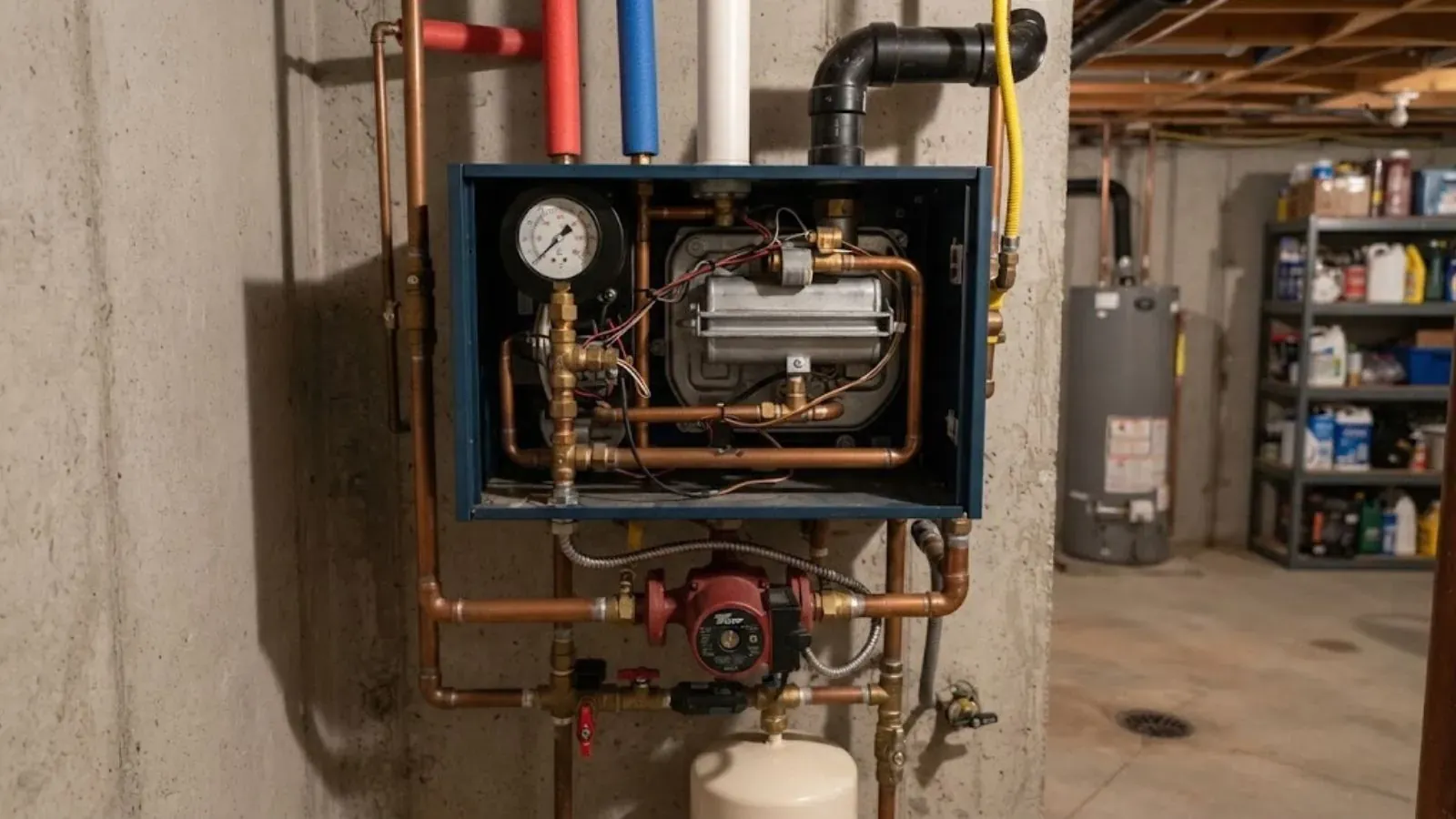
- Look at the pressure gauge. A reading near zero often means water has been lost through a leak or valve.
- Oil boiler: check the tank gauge and the fuel valve. Gas boiler: check the gas valve is open and other gas appliances work.
- Press the reset once only if the manual says to. Repeated resets can flood an oil burner or hide a fault.
House cold and boiler silent?
Once the safety steps are clear, call the 24/7 line. We take no-heat calls any hour, and tell you by phone what you can check while a plumber heads your way.
How hydronic boilers heat a house
A hydronic boiler heats water, then a circulator pump pushes it through pipes to baseboard, radiators or in-floor tubing. Zone valves or additional pumps send heat to each room group. The boiler burns oil or natural gas, and in Connecticut homes that mix is close: roughly 39 percent use fuel oil or kerosene and 36 percent use natural gas, per 2020 federal data.
About half of Bloomfield homes were built before 1970 according to the town plan, so many boilers and piping systems have decades of service behind them. Age does not mean failure, but it does raise the odds of worn valves, rusty fittings and leaking joints.
Symptoms and likely causes
| Symptom | Often points to | Call urgency |
|---|---|---|
| No heat, boiler silent | Power, thermostat, safety limit, fuel supply or ignition fault | Same day in cold weather |
| Boiler runs but radiators stay cold | Trapped air, failed circulator or zone valve | Same day if the house is cold |
| Water on the floor | Leaking relief valve, fitting, expansion tank or the boiler body | Shut off and call promptly |
| Banging, gurgling or kettle noises | Air, scale or low water flow | Soon, before it damages parts |
| Short cycling on and off | Oversized unit, dirty burner or a sensor problem | Soon |
| Soot, yellow flame, odor | Combustion problem | Turn it off and call immediately |
Oil boilers and gas boilers: different faults
Oil boilers
Common problems are a clogged nozzle or filter, a dirty burner, a failed igniter, water in the tank or an empty tank. A burner that locks out after one try is waiting for a technician.
Gas boilers
Faults often involve the ignitor, flame sensor, gas valve, venting or a condensing unit's drain. Newer gas boilers show a code that points to a circuit or sensor.
A gas boiler or gas line problem always follows the gas-smell rule above. A smell of fuel oil from an oil boiler is also a reason to turn the unit off and call. We do not diagnose mold, health effects or structural fire damage after a leak or soot event, so involve your doctor or the fire department when they are in question.
Leaks, pressure and low water
A boiler is a closed loop, so the water level should stay stable. Water pooling under the unit, a pressure gauge that keeps falling or a relief valve that drips are signs of a leak, a failed expansion tank or a bad fill valve. Turn off the boiler and the feed valve, and put a pan under the drip.
Do not add water repeatedly without finding the leak. Fresh water brings oxygen and minerals, which speed up rust inside the boiler. We pressure test the system and trace the loss to a joint, valve or the vessel itself.
Winter in Bloomfield puts stress on every system
NOAA's Connecticut summary reports typical winter lows around 17 degrees Fahrenheit in the northern part of the state, with a few nights a year at or below zero. A boiler that fails during a hard freeze can let pipes in unheated areas freeze too. Open cabinet doors on exterior walls, keep a trickle at vulnerable taps, and call early rather than waiting for the coldest night.
Boiler repair or boiler replacement
Most boiler calls end in a repair. A circulator, zone valve, thermocouple, igniter, nozzle or thermostat is replaceable without touching the rest. A cracked heat exchanger, a boiler body that leaks, or one that needs frequent parts is usually a candidate for replacement.
Efficiency rebates for boilers have existed through Energize CT, but program pages show past dates and we cannot confirm one is open today. Check before you buy. Any boiler work involving gas or water piping must be done by a licensed plumber.
What goes into a boiler repair bill
We diagnose first and give a clear price before work starts.
Ask your insurer how your policy treats heating system damage. Policies often respond to sudden and accidental events like a burst pipe, not to wear, slow leaks or a boiler that has simply reached the end of its life.
Call and describe what the boiler is doing. We will explain the likely repair and give a real number once we see the system.
Keeping the boiler running between service calls
- Schedule an annual inspection before the heating season starts.
- Keep storage, laundry and boxes at least a few feet from the boiler.
- Bleed radiators if they have cold spots at the top.
- Know where the boiler switch, feed valve and fuel shutoff are.
- Test your CO alarms monthly and replace old ones.
We cover homes in West Hartford and Windsor, and our water heater repair team works from the same dispatch line. If a leak starts spreading, a burst pipe call may be the right next step.
Boiler repair questions
Yes. Our dispatch line is open 24/7, including holidays, and no-heat calls get priority in cold weather. If you smell gas or a CO alarm is sounding, leave the house and call Connecticut Natural Gas at 866-924-5325 or 911 before you call us.
Leave the building right away and call Connecticut Natural Gas or 911 from outside. Do not use switches or phones inside. We come after the gas utility clears the home.
Air trapped in the pipes, a failed circulator or a stuck zone valve are common causes. We check flow and zone controls to find which.
Yes, we handle repairs on hydronic oil and gas boilers. Tell us the fuel and brand when you call.
Low pressure usually means water has escaped through a leak or valve, or the expansion tank has failed. Do not keep refilling it. Call us to find the loss.
Noises often come from air or scale and are not an emergency. If the sound comes with soot, smell or leaks, shut the boiler off and call.
Replacement makes sense when the heat exchanger or boiler body fails, or when repairs keep adding up. Otherwise a repair is usually the better choice.