
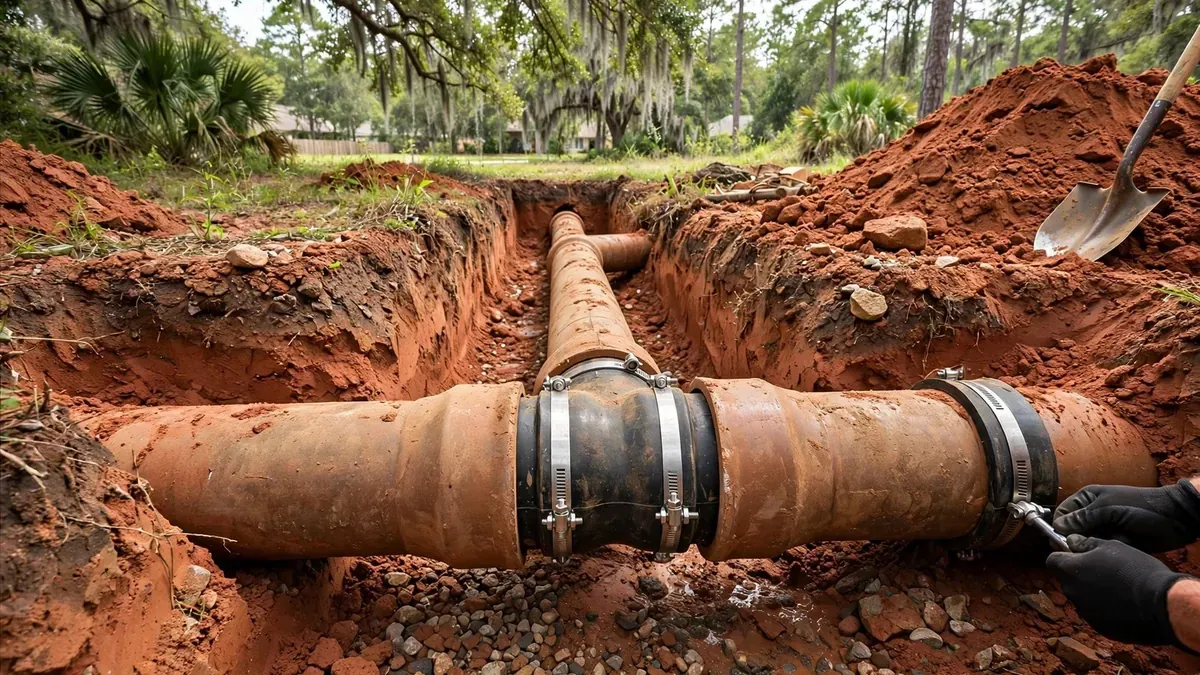
A broken sewer pipe can announce itself as a backup at two in the morning or as a slow problem you have been snaking for a year. Either way, our dispatch line answers 24/7, and plumbers book same-day appointments when the schedule allows. If wastewater is in the house now, stop using water, keep people out of the wet area, and read the first-steps list below while you wait.
Sewer line repair means fixing a damaged section of the drain pipe that carries waste from your house to the public sewer, or replacing the whole run. In an MDC town like Bloomfield, that pipe is the lateral, and the property owner owns all of it. The repair can be a short patch, a liner inside the old pipe, or a new pipe in a trench.
When a failed sewer line is an emergency
Sewage is backing into the house
A collapsed or fully blocked pipe stops flow. Call right away, stop water use, and expect the plumber to clear the line first to relieve the backup, then camera it.
Sinkhole or wet patch in the yard
A sunken area over the lateral, or soggy ground that smells of sewage, can mean a break leaking into the soil. Keep people and pets away and call.
Repeat clogs in the same place
A cable that stops at the same distance every time is meeting a collapse, offset joint or root mass. This is urgent in the sense that it will worsen, not that it floods tonight.
Backups only in heavy rain
If the lateral is cracked, groundwater may be entering. That is a repair question, and MDC's inflow rules may be involved.
If you are unsure whether it is an emergency, assume it is when sewage is entering living space. A plumber can stabilize the situation first and plan the permanent fix after.
Finding the break before deciding anything
Clear the line
The plumber opens the pipe with a cable or jetter so a camera can travel through it. Without clearing, the lens sees only debris.
Run the camera
A waterproof camera on a flexible rod shows cracks, root entry, offset joints, bellies where water pools, and any collapse. The plumber notes distance to each problem.
Locate the problem on the surface
A transmitter in the camera head lets the plumber trace the pipe from above and mark depth and position. That decides how much digging, if any, the repair needs.
Explain the options
You see the footage, the distances and a plain recommendation. Findings can include a short break, a long deteriorated run, or a pipe that is fine and a main that is not.
The same camera work is described on the sewer inspection page for buyers and owners who want a look without a backup.
Trenchless repair or digging: the honest trade-offs
Trenchless methods work through small access holes instead of a full trench. Lining slides a resin-saturated liner into the old pipe and cures it into a new pipe inside the old one. Pipe bursting pulls a new pipe through while breaking the old one outward. Excavation opens the ground, removes the failed section, and installs new pipe.
| Factor | Trenchless lining or bursting | Excavation |
|---|---|---|
| Yard and landscaping | Small access pits, less disturbance | Open trench, more restoration |
| Under driveways, patios, trees | Often avoids cutting them | May require removal and replacement |
| Collapsed or badly offset pipe | Lining may not work, bursting may | Often the more certain fix |
| Short, shallow break | Possible, but may be more than needed | Often a quick spot repair |
| Connections and laterals | Needs reinstating through the liner | Fittings installed directly |
| Permit and inspection | Sewer permit and MDC inspection | Sewer permit and MDC inspection |
No method is best for every pipe. A short, shallow break in an open yard is often simplest to dig. A long run under a driveway or mature trees often favors trenchless work. The camera footage and the depth readings decide, not preference, and a good plumber tells you when the cheaper-looking option will not hold.
Camera showed a break and you need answers fast?
Call the 24/7 line with the distance and depth from the footage. A plumber can discuss trenchless and excavation options by phone and often visit the same day.
Bloomfield lateral rules to know before work starts
MDC's sewer ordinance puts maintenance and repair of the entire house connection on the property owner. MDC says it does not take responsibility for the lateral. If the main is clear and the problem is your pipe, the work is yours to arrange.
Repairing or installing a lateral on private property needs an MDC sewer permit, and MDC inspects the work. MDC calls for a licensed, bonded and insured contractor. Call MDC first, because MDC says it will not accept liability for work done without notice.
Replacing a hidden drain with new material is also new work to the Bloomfield Building Division. It needs a plumbing trade permit, separate from any building permit, and inspections are scheduled 48 hours ahead. The office is at 800 Bloomfield Avenue, phone 860-769-3516. Simple clearing and leak patches that replace nothing are exempt.
Permit and inspection steps for new drain work follow the IPC, the model code behind the 2022 Connecticut State Building Code, so ask the Building Division what it will inspect.
Digging brings its own rule. Connecticut law requires excavators to contact Call Before You Dig, by dialing 811, before breaking ground. Your contractor should make that call before any trench is opened.
Bloomfield, CT: ask MDC about help paying for the work
MDC's Sewer House Connection Program has offered funding toward inspection, repair, replacement or lining of an eligible lateral. MDC pays its own contractor or the owner's qualified contractor if requirements are met, and the program has a one-time limit per property.
The practical step is to call MDC Utility Services at 860-278-7850 ext. 3780 before signing anything. Eligibility, steps and amounts change, and a spot repair may not qualify where full-length work does. MDC's Water and Sewer Service Installation Program also lets MDC pay upfront with the owner repaying through the water bill over 15 or 20 years.
Who is allowed to do the work
Connecticut licenses plumbing under the Department of Consumer Protection. A P-1 Unlimited Plumbing Contractor or P-2 Unlimited Journeyperson can do all plumbing work. A P-6 or P-7 Limited Sewer, Storm and Water license covers lines from the utility connection to just inside a building. You can verify any license against the scope page on the state DCP site before you hire. Our plumbers are licensed and insured.
Roots, bellies and old pipe: what the footage often shows
Roots enter at joints and cracks, and cutting them only buys time unless the opening is sealed. A belly is a low spot where the pipe has settled, so water and solids collect instead of draining. Older pipe can crack, flake or shift over decades. About 52 percent of homes in the town's proposed plan were built before 1970, so original laterals are common here.
Each condition has a different remedy. A root-damaged joint may need a short repair, a long belly may need replacement, and a stable pipe with surface wear may be fine with periodic sewer line cleaning. When the footage shows heavy scale or grease only, hydro jetting may remove the need for repair.
What drives the cost of sewer line repair
A sewer repair price depends on the pipe and the ground, so we give a clear price before work starts and only after seeing the footage.
Ask your insurer how your policy treats sewer line damage. Many homeowners policies cover sudden and accidental damage but not wear, age or root intrusion, and backup coverage is often a separate endorsement.
Send us the camera footage or call with the distance and depth, and we will explain what the real number depends on.
We handle sewer calls in Hartford and nearby towns that share MDC service.
Sewer line repair questions
Yes. Dispatch answers 24/7. For an active backup, a plumber first clears the line to stop sewage entering the house, then cameras it to plan the repair. Same-day visits are offered when the schedule allows.
No. Trenchless work suits long runs under driveways, patios or trees, and pipes still intact enough to line or burst. A short shallow break in open ground is often simpler to dig, and a collapsed pipe may require excavation. The camera and depth readings decide.
Under MDC's ordinance the owner maintains and repairs the entire house connection. MDC maintains the public main. Call MDC before any lateral work and ask about its Sewer House Connection Program.
Yes for most repair or replacement. MDC requires a sewer permit for work on a lateral on private property and inspects it, and Bloomfield requires a plumbing trade permit for replacing a concealed drain with new material. Clearing a clog or patching a leak without replacing pipe is exempt.
Often, yes, through trenchless lining or bursting, if the pipe suits it. Small access pits are still needed at each end. We explain what would be disturbed before work starts.
A camera is the only way to be sure. A cable can clear a clog and still leave a crack or belly behind. If clogs return in the same spot, ask for footage.
MDC has offered funding through its Sewer House Connection Program for eligible customers who follow its process. It has also offered an installation program with repayment on the water bill. Check current eligibility with MDC before work starts.