
If your main drain is blocked and a cable has already failed, you are likely tired, behind on laundry and wondering what is left to try. Our 24/7 dispatch line takes these calls at any hour, and same-day appointments are available when the schedule allows. Until a plumber arrives, keep water use to a minimum, because every flush and shower adds to the standing water behind the blockage.
Snaked it and it came back? What is probably happening
A drain that clears for a few weeks and slows again is not mysterious. A cable spins through the middle of a pipe and cuts a channel through the blockage. The coating on the pipe walls stays put, and it starts catching debris again right away.
The same thing explains a cable that stops short. A plumber feeds the snake in, hits something at 60 feet and cannot pass. The obstacle might be a dense root ball, a heavy grease plug or a damaged section of pipe, and a cable alone cannot tell which.
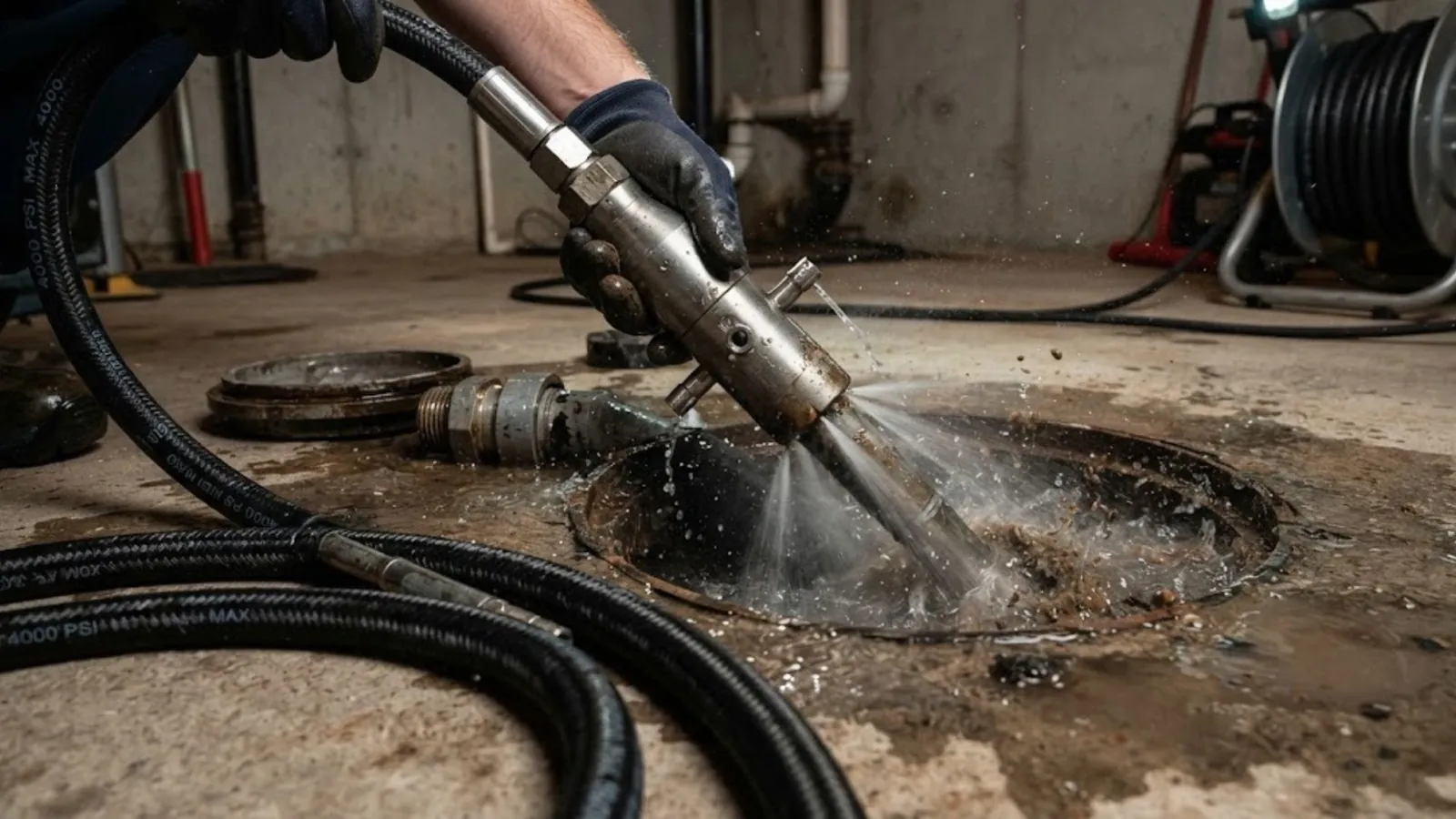
The technical name for the fix is hydro jetting. A jetter pumps water through a hose with a nozzle that fires jets forward and backward. The forward jets break up the obstruction, and the rear jets pull the hose along and scrub the pipe wall as they go. What comes out is flushed to the cleanout or down the line.
What a jetting visit includes
Locate the access point
The plumber finds a cleanout, often outside near the foundation or in the basement. Jetting needs a way into the pipe, and a cleanout is far safer than pulling a toilet.
Look before jetting
A drain camera goes in first when the line allows it. This shows roots, a belly, a cracked joint or a collapsed section, which tells the plumber whether jetting is safe.
Run the jetter
The hose is fed in slowly, section by section, with the nozzle working back and forth over the worst spots. Water and debris wash back toward the access point.
Camera again and test
A second camera pass confirms the walls are clean and shows any damage the buildup was hiding. Then water runs through the fixtures to prove the line is open.
Jetting versus snaking: how the two differ
| Question | Cable snaking | Hydro jetting |
|---|---|---|
| What does it do to the pipe wall? | Cuts a channel and leaves a coating | Scours the wall back toward bare pipe |
| Handles grease buildup? | Partly | Yes, this is its best use |
| Handles roots? | Cuts them back | Cuts and flushes them, but roots can regrow from the pipe joint |
| Good for a damaged pipe? | Risky if the pipe is weak | Needs a camera check first, and may be ruled out |
| Typical use | A single clog | A line that keeps slowing down |
Plain cable work is still the right first call for many clogs, and it is covered under drain cleaning. Jetting is for lines where the problem is the buildup itself, not one object.
When jetting is the wrong call
A jetter is powerful, and that is a reason to check the pipe before using it. Water at that pressure can enlarge a crack, push through a failed joint, or flood soil around a broken line. A responsible plumber does not jet a pipe they have not looked at, and a camera is cheap insurance against making the problem worse.
Signs the line needs a camera before any jetting
If any of these apply, tell the dispatcher so the plumber brings the right equipment.
- A previous cable stopped at the same spot more than once.
- The line is made of clay, cast iron or old fiber pipe that has not been inspected.
- A section of yard over the sewer has sunk, stays wet or smells of sewage.
- Backups started after digging, a nearby tree removal or heavy construction.
- A snake head or broken cable is still in the pipe.
- The house sits in an older neighborhood where the lateral may be original.
Bloomfield's proposed town plan says about 52 percent of local homes were built before 1970. Laterals from that era are often older materials, so the camera step matters. If the camera shows a crack or collapse, jetting will not fix it, and we move to the repair discussion on the sewer line repair page.
Cable would not pass and the line is full?
Call the 24/7 line and tell the dispatcher how far the snake went and what came out. We can often send a plumber with a jetter and a camera the same day, even after hours.
Grease, roots and scale in Bloomfield drains
Three things build up inside residential lines. Grease is the most common in kitchen drains and the main reason MDC runs a fats, oils and grease program. Roots enter through joints and small cracks in the sewer lateral, and they come back unless the joint is repaired. Scale is mineral crust that forms on pipe walls.
Bloomfield, CT: soft water changes what jetting is for
MDC states that its drinking water is soft, with hardness of about 15 mg/L, roughly 1 grain per gallon. That is low compared with many hard-water regions.
Here that means hard mineral scale is a smaller part of most Bloomfield buildups than it is elsewhere. Expect grease, soap, hair and roots to be the usual targets, and treat heavy crust in a drain as a sign of an older pipe or a different problem.
MDC's residential guidance is to cool and seal cooking fat for the trash, wipe pans with a paper towel, and never rinse grease away with hot water and soap. Jetting resets a kitchen line, but only habits keep it clear.
A blocked main line is an emergency
A fully blocked main means sewage has no exit, and the lowest fixture in the house takes the load. That is usually a basement tub, shower or floor drain.
Stop all water use and keep people and pets away from the affected area. If sewage is on the floor, wear gloves and keep electrical items out of the water. MDC's sewer emergency page also advises stopping use of fixtures, avoiding contact and disinfecting afterward. If the backup may involve the street main, MDC's Command Center is at (860) 278-7850, option 1.
A plumber can often tell within minutes whether the blockage is in your lateral or in the main. The lateral from house to main is the owner's responsibility under MDC's ordinance, and MDC's Sewer House Connection Program has offered funding for eligible repair or lining work. Ask MDC about eligibility before hiring, because the program has its own steps.
Restaurants, multi-unit buildings and shared lines
Buildings that put a lot of grease or laundry through one line need jetting on a schedule, not just once. MDC's program for food businesses requires certain food service operators to use grease recovery units or interceptors and to have them cleaned at least quarterly. Those rules govern the interceptor, but the pipe leading to it still needs routine care.
Property managers with a stubborn main can read more on commercial plumbing. Homeowners with a shared line in a duplex or condo should tell us who else uses the pipe.
What shapes the cost of hydro jetting
You get a clear price before work starts, based on the specifics of your line.
Ask your insurer how your policy treats sewer or drain backup. Standard homeowners coverage often excludes it unless you added a backup endorsement.
Tell us what you have tried already and we will explain what a jetting visit would involve before anyone is sent.
Keeping a jetted line clean
- Scrape plates into the trash and pour cooled fat into a sealed container.
- Flush only toilet paper. EPA says wipes belong in the trash.
- Keep large trees from growing over the sewer lateral.
- Ask for a follow-up camera look if a line was jetted twice in a year.
- Do not send roof, yard or foundation drains to the sanitary sewer. MDC's ordinance bars storm water and groundwater from sanitary sewers.
We serve Windsor and other towns near Bloomfield with the same jetting and camera equipment.
Hydro jetting questions
Yes. Our dispatch line runs 24/7, and a plumber with a jetter and camera can often come the same day when the schedule allows. If sewage is rising in a tub or floor drain, call right away and stop using water in the house.
It is safe for sound pipes, and a camera check confirms that first. We do not jet a line that shows a crack, a collapse or a failed joint, because the water could make the damage worse. In that case the next step is a repair plan.
It clears the roots from the pipe, but it does not stop regrowth. Roots follow moisture into joints, so a line with root entry may need periodic jetting or a joint repair. The camera shows where they are getting in.
A cable cuts a channel through a blockage. A jetter scours the pipe wall with water and flushes the debris out. Jetting is usually the better answer for grease buildup or a line that keeps clogging.
If the cause is buildup in the branch or main line, yes. If the toilet itself or its trap is the problem, a cable or toilet repair is the right fix. A camera look tells which one you have.
Under MDC's sewer ordinance, the owner maintains and repairs the entire house connection. MDC maintains the main. Call MDC before work on the lateral and ask about its Sewer House Connection Program.
Clearing a clog is on the town's permit-exempt list as long as no pipes, valves or fixtures are replaced or rearranged. If the camera finds damage that leads to replacement work, that work does need a plumbing permit. The Building Division can confirm at 860-769-3516.