
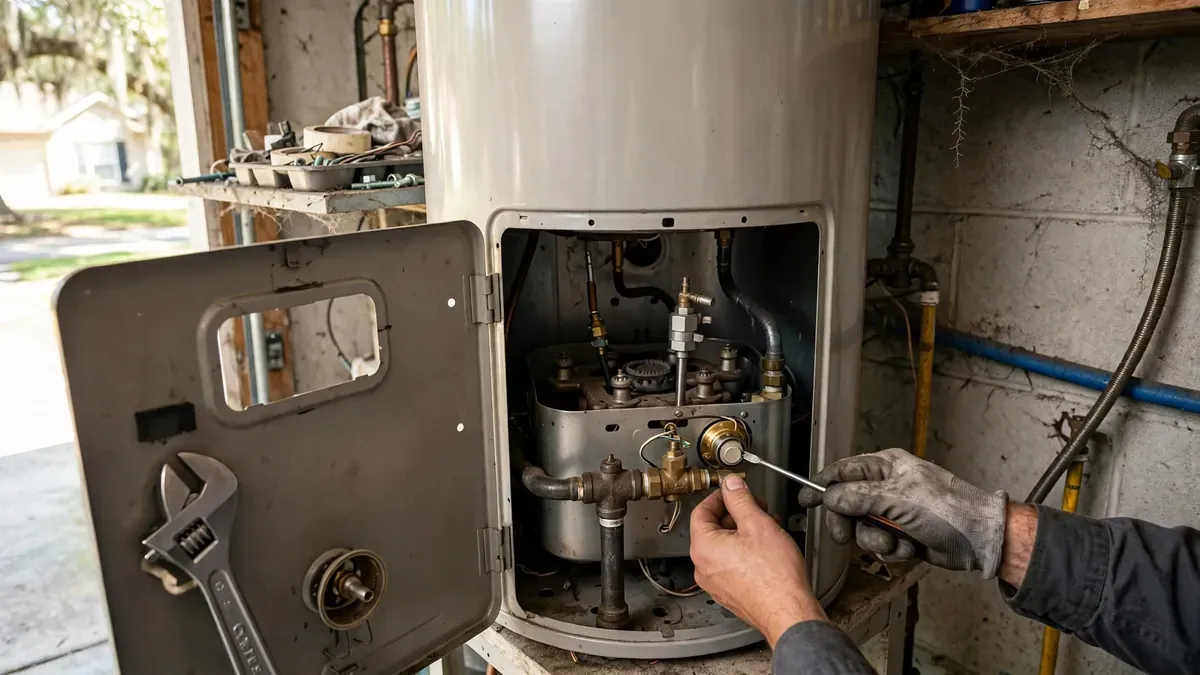
Start with what your heater is doing
Hot water trouble in Bloomfield, CT is usually one of four things: water where it should not be, no heat at all, heat that fades fast, or a noise or smell that was not there last week. If any of those is happening right now, our 24/7 line is open, and the table of symptoms below shows what each one tends to mean. Shut the cold water to the tank if anything is dripping.
Water around the base
Could be a loose fitting, a dripping relief valve or a failed tank. Wipe it dry, tape a paper towel to the spot and check again in an hour to see where it returns.
No hot water at all
Electric units often point to a tripped breaker, high-limit button or dead element. Gas units point to a pilot, thermocouple or gas valve.
Lukewarm or short-lived hot water
A broken lower element, a cracked dip tube or heavy sediment is a common cause. The tank may also simply be too small for the household.
Popping, rumbling or rotten-egg smell
Sediment cooking on the bottom causes the noise. A sulfur smell can come from bacteria reacting with the anode rod, and a flush sometimes helps.
A leaking water heater is an emergency
A slow drip from a pipe fitting is a repair. Water coming from underneath the tank jacket is usually a failed tank, and a stream of it can fill a basement fast. We treat both as urgent, and our 24/7 line takes the call at any hour.
While you wait for us
Do these in order. They protect your floor and your family.
- Close the cold water supply valve on top of the heater.
- Switch off the breaker for an electric unit or set a gas control to off.
- Smell gas or hear hissing? Leave the house and call Connecticut Natural Gas at 866-924-5325 or 911 from outside before you call a plumber.
- Put a bucket or wet vac under the leak and move belongings off the floor.
- Keep people and pets out of any room with standing water and live outlets.
- Note the brand, age and fuel type from the label so we can bring the right parts.
Water coming from the tank?
Stop the supply, kill the power or gas, then call the 24/7 line. We take same-day appointments when available and can tell you by phone whether this sounds like a repair or a replacement.
How we find the fault
A good diagnosis takes less time than guessing. We look at the label for age and fuel, then test the parts that match your symptom. A multimeter checks elements and thermostats on electric heaters, and a manometer or flame check covers gas units.
Listen to the story
When did the problem begin, and has anything changed, such as a power outage, a new appliance or a plumbing job?
Inspect the unit
We check the base, fittings, relief valve, flue and venting, anode rod access and the condition of the pan.
Test the controls
Voltage, continuity, thermocouple output and thermostat settings tell us which part failed and which are fine.
Give you the options
You hear what is wrong, what the repair involves and whether the tank is worth saving, all before any work begins.
Parts that fail most and what each repair involves
| Part | What it does | Typical sign it failed |
|---|---|---|
| Heating element (electric) | Warms water in the tank | Lukewarm water or no hot water |
| Thermostat or high-limit switch | Controls and cuts off heat | Water too hot, too cold or no heat at all |
| Thermocouple or flame sensor (gas) | Proves the pilot or burner is lit | Pilot will not stay on, error code shows |
| Gas control valve | Meters gas to the burner | No flame even with a good sensor |
| Temperature and pressure relief valve | Opens if heat or pressure climb too high | Drip or steady discharge from the discharge pipe |
| Anode rod | Corrodes first so the tank does not | Rust-colored water, rotten-egg smell, age over several years |
Some failures are cheap to fix. Others, like a leaking tank shell, cannot be repaired at all and call for a water heater replacement. We tell you which category you are in.
Gas units: pilot, flame and error codes
A gas heater that keeps losing its pilot often has a worn thermocouple or a dirty burner assembly. Newer units report faults as numbered codes on a display or flashing light, and a code near the top of a manual often points to a vent, sensor or ignition issue. We look up the code for your model and test the part before replacing it.
Burned wires, scorched paint or a yellow flame mean stop using the heater. Turn it off at the control and call us. Never remove a burner shield while the unit is lit.
Why a tank may not be worth repairing
A heater about 15 years old with a steady drip has likely corroded through, and the next part will not help. Repairs also stop making sense when the tank is old and needs multiple parts at once. We would rather say so than sell you a fix that fails next month.
What Bloomfield water bills can tell you
MDC bills for every unit of water that passes through your meter, including water that leaks away. If your water bill climbs and you see no running fixtures, check the heater base, the relief valve discharge pipe and the nearby supply lines. A hidden drip can run for weeks, and the meter records all of it.
Service and flush to avoid the next breakdown
Plenty of calls are not breakdowns at all. People ask for a service visit, a flush or a new anode rod because the heater is getting older. MDC describes its water as soft, about 15 mg/L or 1 grain per gallon, so scale builds more slowly here than in hard-water areas, but sediment and rod wear still happen.
According to the DOE, storage tank heaters typically last 10 to 15 years, so a unit past that age is a repair-versus-replace decision.
A flush clears sediment from the bottom of a tank, and swapping a spent anode rod can slow corrosion if the steel is still sound.
- Flush once a year, or sooner if the tank rumbles or runs cloudy.
- Test the relief valve lever gently and make sure it snaps back.
- Look for rust at the bottom seam, fittings and the drain valve.
- Check the pan and discharge pipe for staining or drips.
- Have gas units checked for draft and flue condition each year.
If you own a tankless unit, descaling is its own job with its own tools. Our tankless water heater page covers service, flushing and when repair is worth it.
Dead heater after a power or plumbing job
Callers often report that a newly installed or recently serviced heater will not heat. Common culprits are a switched-off breaker, a gas valve left closed, an air pocket in the lines or a reset button that tripped. If you had a heater installed recently and it is not heating, call us and tell us who did the work so we can check the connections and settings.
What affects the cost of a water heater repair
We diagnose first and give a clear price before work starts.
Ask your insurer about coverage. Policies often respond to sudden and accidental water damage, but not to a tank that wore out or leaked slowly over time.
Describe your symptoms on the phone and we will explain what a likely repair involves and give you a real number once we see the unit.
Doing it safely and legally in Connecticut
Connecticut classes gas and water piping as plumbing work, so a licensed plumber should handle the gas connection, relief valve and venting. Electric heaters also involve wiring, which Connecticut treats as a separately licensed trade, and we plan that part when a repair goes beyond the heater's own parts.
Under Bloomfield's exempt-work list, repairing leaks in pipes, valves and fixtures needs no permit as long as nothing is replaced or rearranged. Anything beyond that is a question for the Building Division at 800 Bloomfield Avenue, reachable at 860-769-3516.
Nearby towns such as Windsor and Avon are on our dispatch map, and the same process applies there.
Water heater repair questions
Yes. Our line is open 24/7 including holidays. If the tank is leaking, the home smells of gas or the pilot area is scorched, treat it as urgent. Shut off the supply, turn off the power or gas, and call. We book same-day appointments when available.
Water at the base can come from a loose connection, a drain valve or the tank itself. If the tank shell is leaking, replacement is the only fix. We trace the source before we recommend anything.
On electric units, check the breaker and the high-limit reset button first. On gas units, look to see whether the pilot is lit. If those are fine, the heating element, thermostat, thermocouple or gas valve could be the cause.
Yes. A yearly flush and anode check often extend the life of a tank, and we can also inspect the relief valve and venting during the same visit.
Write down the code, turn the unit off if it is a gas heater with a flame or smell problem, and call us. Codes point to a part category, and testing confirms which one has failed.
A leaking tank, heavy corrosion or a unit with several failing parts is usually a replacement case. Our replacement page explains how that works.