
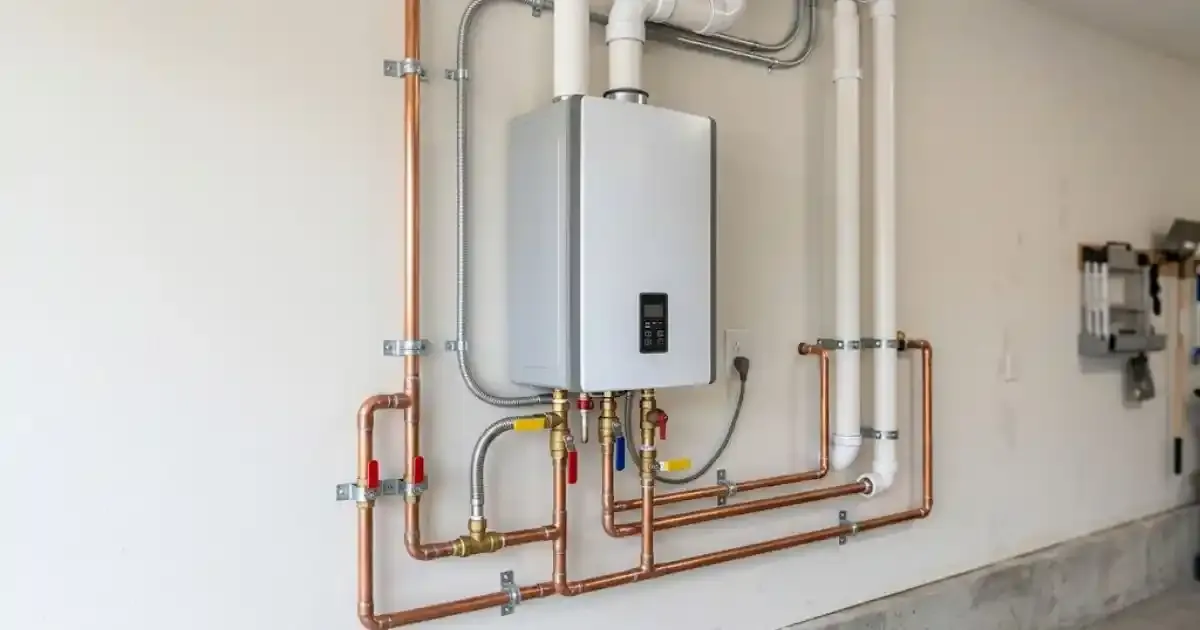
When the hot water runs out in the middle of the day
Bloomfield homeowners often reach for a new heater after a string of cold showers, a tank that takes forever to recover, or a basement closet they would like back. A tank holds a fixed amount of hot water. Once it is used, you wait. A tankless water heater, also called an on-demand heater, heats water as it flows through the unit, so there is no tank to empty.
That is the whole idea, and it fits some homes very well and others poorly. The sections below explain which is which, so you can decide before you pay for anything.
Does tankless make sense for your house?
The U.S. Department of Energy says tankless heaters can run about 24 to 34 percent more efficiently than storage tanks in homes using 41 gallons or less of hot water a day. At about 86 gallons a day, the gain drops to roughly 8 to 14 percent.
Gas tankless units save the most near 50 gallons a day, and they save less on short, small draws. Tankless units typically last 20 years or more, compared with 10 to 15 for a tank.
| Question | Storage tank | Tankless |
|---|---|---|
| How hot water is made | Heated and stored ahead of time | Heated as it flows |
| Running out | Possible after heavy use | Not from volume, but flow can limit several taps at once |
| Space | Needs floor space | Wall-mounted, smaller footprint |
| Typical lifespan (DOE) | 10 to 15 years | 20 years or more |
| Upgrades needed | Often none | Gas supply, electrical capacity and vent may change |
| Maintenance | Flush the tank, check the anode rod | Descale the heat exchanger, clean filters |
If your house runs the dishwasher, shower and washing machine together, the unit has to be sized for peak flow, not just daily use. We ask about your fixtures and calculate the temperature rise from your incoming water.
What changes in the house when you go tankless
Gas supply
A gas tankless unit burns a lot of gas at once. Your existing line and meter must be able to deliver it, so we check that before quoting.
Venting
These units are vented with materials and lengths set by the manufacturer. Venting is not a place for substitutions.
Electric capacity
Electric models draw large current. Connecticut treats wiring as a separately licensed trade, so a licensed electrician handles the circuit.
Connecticut Natural Gas serves Bloomfield, so most gas jobs start with the existing gas meter and line. Gas and water piping count as plumbing work in Connecticut, which keeps those parts with licensed plumbers. The Building Division at 860-769-3516 can say what permits apply, since its exempt-work list does not cover water heaters.
Soft water helps, but does not replace maintenance
MDC states that Bloomfield's water is soft, around 15 mg/L or 1 grain per gallon. Softer water leaves less scale on a heat exchanger than hard water does. Even so, many manufacturers call for periodic flushing, and a unit that hums, fluctuates or throws error codes should be inspected.
Ready to price a tankless swap?
Call and tell us your fuel, your fixtures and your current heater. We book same-day appointments when available and can often outline the scope on the phone.
Limits to know before you buy
A tankless heater has a maximum flow at a given temperature rise. Run two showers and a dishwasher at once in a cold month and the unit may not keep up, and the water at the farthest tap can turn lukewarm. Winter incoming water is colder, which lowers the flow a unit can heat. We size for the cold-month case, not the summer one.
You may also wait a few seconds for hot water to travel from the wall unit to a distant bathroom, just as with a tank. A small recirculation setup can help in some homes, and we say so when your layout calls for it.
Replacing a tank with an on-demand unit
Callers often ask about replacing an old tank, or even a salt tank they mistake for a water heater, with a modern on-demand unit. The job takes more planning than a tank swap. The old tank comes out, the new unit mounts on the wall, and the gas, water, vent and condensate lines are redone for the new equipment.
Walk through the home
We note fixtures, peak use, current fuel, vent route and electrical panel capacity.
Choose and size
We pick a model that can deliver the flow you need at your incoming water temperature.
Install to the manual
Isolation valves, vent kit, condensate drain and gas or electric connections follow the manufacturer's rules and local code.
Commission and teach
We test combustion and flow, set temperature, and show you how to read the display and shut it off.
If you only need a standard tank, our installation page and replacement service cover that.
Flushing and descaling a tankless unit
People often ask us to flush, not replace, a tankless heater. That is a real service. We close the water and gas, connect a pump and hoses to the service valves, circulate a descaling solution through the heat exchanger, then rinse thoroughly and restore the unit. We also clean the inlet filter.
Flushing helps when the unit gives lukewarm water, surges between hot and cold, or displays a scale or temperature code. It does not fix a failed sensor, an exhaust problem or a cracked exchanger. We tell you which problem you have.
Tankless water heater repair
A tankless heater that stops working often shows an error code. Different brands use different numbering, so we read the manual for your model. Typical causes include a blocked vent, a dirty flame sensor, a burned wire, a failed igniter, low gas pressure or mineral buildup.
- Check that the gas valve is open and the unit has power.
- Look at the display and write down any error code before resetting.
- Smell gas? Leave the house and call Connecticut Natural Gas at 866-924-5325 or 911 from outside before you call us.
- Note any dripping at the unit, vent or connections, since a leaking unit needs to be shut off.
- Tell us the brand, age and whether it was installed by someone else.
Some plumbers decline to work on tankless units they did not install, and callers tell us that is a frustration. We service and replace them, and we say when a unit is past repair. Basic tank issues are handled by our water heater repair team.
Venting, carbon monoxide and safety
Gas tankless heaters vent combustion gases outside, and a failed or mismatched vent can allow carbon monoxide into a home. Use only vent materials listed for your specific model. Connecticut health officials advise yearly inspection of heating systems, flues and gas appliances, with alarms on every level and near sleeping areas, replaced every 7 to 10 years.
What drives tankless pricing
Prices vary a lot between jobs. We give you the number before work starts.
Ask your insurer how your policy treats a heater upgrade. Policies generally cover sudden and accidental damage, not wear or slow leaks.
To get a real price, call and describe your home and fixtures. We will explain what the job involves.
If you live in Avon or West Hartford, we serve you as well.
Tankless questions
It can. The Department of Energy says savings are larger in homes with lower hot water use. At about 86 gallons a day the gain is smaller, so your household's habits matter.
Follow your manufacturer's schedule. MDC water is soft, so scale may build more slowly than in hard-water areas, but a yearly check is still a reasonable habit.
Yes. We diagnose the error code and test the sensors, igniter, vent and gas supply, then tell you whether a repair makes sense.
Possibly. A tankless unit uses gas fast, so we check the line and meter before quoting.
Shut off the water and power or gas to the unit, then call us. A leak can come from a fitting, the heat exchanger or the condensate line.
Sometimes. Your electrical panel needs the capacity, and a licensed electrician must handle the circuit.
Plumbing work has its own trade permit. Ask who is pulling each permit before you sign, and call the Building Division at 860-769-3516 with questions.