
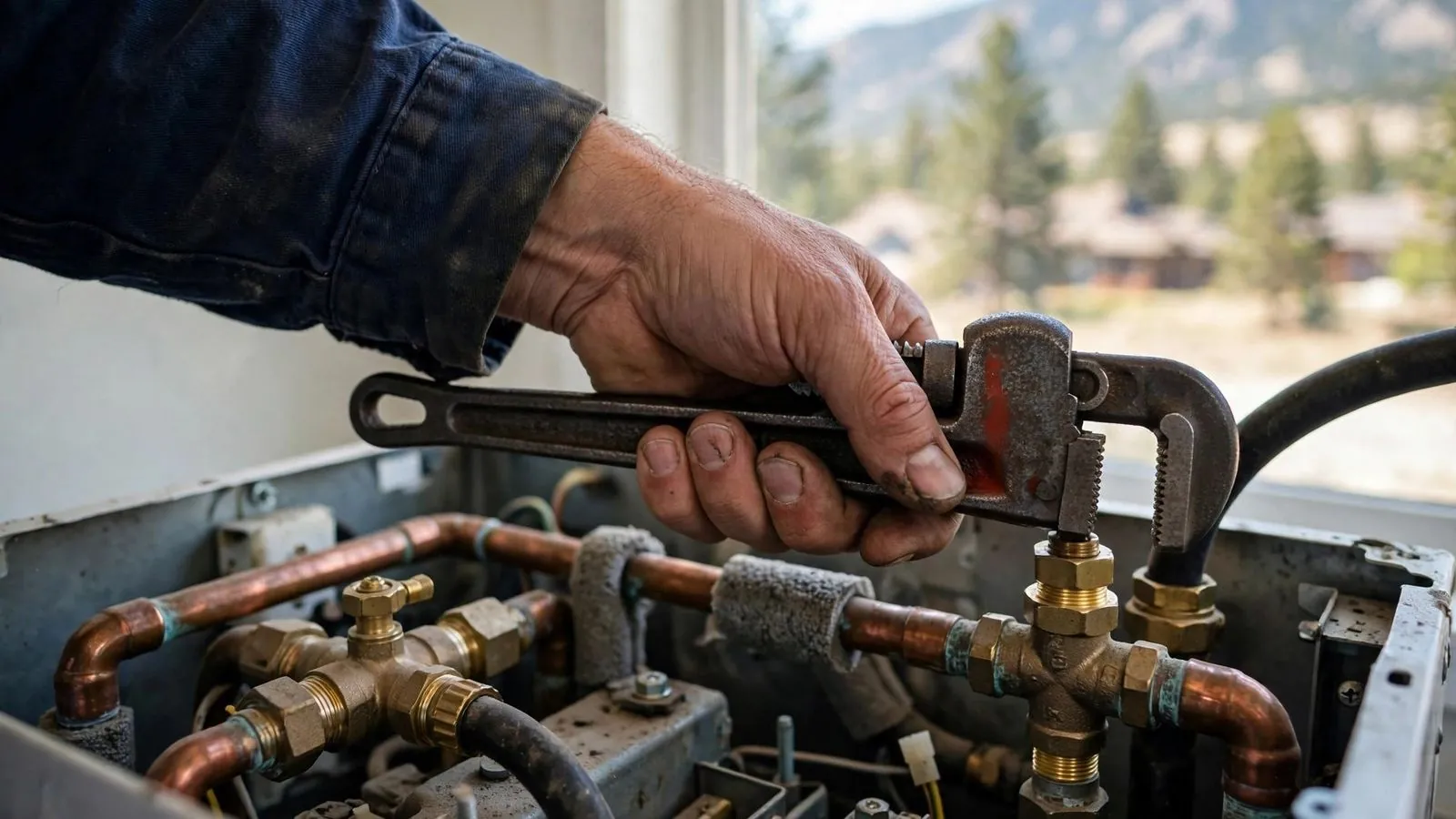
Safety comes before any repair
Boilers burn fuel and hold hot, pressurized water. Both facts shape what you should and should not touch. Read this section before anything else, because a mistake here is not a heating problem. It is a safety problem.
If you suspect gas or carbon monoxide
Handle these in order. Do not call a plumber until the first steps are done.
- If you smell gas, leave the building at once. Do not flip switches or use a phone inside.
- From outside, call your gas utility or 911 before you call a plumber.
- If a carbon monoxide alarm sounds, get everyone outside into fresh air and call 911.
- Do not relight a pilot or restart the boiler after a gas smell.
- Do not return until the gas utility or fire department says the house is clear.
The Connecticut Department of Public Health advises yearly inspection of heating systems, flues and gas appliances, plus carbon monoxide alarms on every level of the home. Replace alarms on the schedule printed on the unit, which for most models falls between 7 and 10 years.
How Connecticut homes are heated
A hydronic boiler heats water and sends it through pipes to baseboard, radiators or in-floor tubing. It is different from a furnace, which blows warm air through ducts. Many older Connecticut houses use hydronic systems, and a lot of them burn oil.
Federal data for 2020 shows about 39% of Connecticut homes heated mainly with fuel oil or kerosene and about 36% with natural gas. Electricity covered about 19% and propane about 4%. That split is why we see both oil-fired and gas-fired boilers in the same neighborhood, and why the repair steps differ.
| Fuel | Typical failure | What it tells us |
|---|---|---|
| Oil | Burner lockout, clogged nozzle, dirty filter or sludge | Fuel quality, a missed annual cleaning or a low tank |
| Oil | Soot on the boiler or smoke at the flue | Poor combustion that needs a technician right away |
| Gas | Ignition failure, dirty flame sensor or pilot out | A part is worn or dirty, but a gas smell changes everything |
| Either | Low water pressure or a leaking relief valve | A leak, a failed expansion tank or a bad fill valve |
| Either | Circulator or zone valve stuck | The boiler works but heat never reaches the rooms |
When a boiler failure is an emergency
Some boiler problems can wait for a normal appointment. Others cannot. Treat these as urgent and call our 24/7 line, including nights and weekends.
- No heat when outdoor temperatures are at or below freezing, because pipes can split.
- Water pooling around the boiler or dripping from the relief valve line.
- Banging, loud rumbling or steam from a hot-water system.
- Black soot around the boiler, or an oil smell in the basement.
- Any gas smell or alarm, which goes to your gas utility or 911 first.
We book same-day appointments when available, and the emergency line stays staffed after hours. Tell the dispatcher what you hear, see and smell. A short, clear description helps the plumber bring the right parts.
Common failures and what they look like
No heat at all
Start with the thermostat, the boiler's power switch and the oil tank gauge or gas valve. A tripped breaker or empty tank explains many calls.
Heat in some rooms only
Trapped air in a baseboard loop or a stuck zone valve is common. The boiler runs but one zone stays cold.
Banging or gurgling pipes
Air in the lines, low water or a failing circulator pump makes noise. Ignoring it can damage the pump.
Pressure too low or too high
Many residential boilers run at roughly 12 to 15 psi when cold, but your manual sets the real number. A reading far outside that range points to a leak, a bad fill valve or a waterlogged expansion tank.
Short cycling
The boiler turns on and off every few minutes. An oversized unit, a dirty sensor or a poor thermostat location can cause it.
Leaks around the unit
A weeping valve, a corroded fitting or a failing heat exchanger can leak. A leak at the exchanger usually points toward replacement.
What a homeowner can safely check
You can do a few things without opening the boiler. Confirm the thermostat is set to heat and a few degrees above room temperature. Check that the switch on or near the boiler is on and that the breaker has not tripped.
For oil, look at the tank gauge and confirm the fuel valve is open. For gas, make sure other gas appliances work, which tells you the supply is on. If the boiler has a reset button, press it once. A second lockout means a technician should look at it, and repeated resets can flood the combustion chamber.
Do not remove covers, relight a pilot you are unsure about, or bleed radiators on a system you do not understand. Never close the relief valve line or plug it. That valve is the last safety control on the boiler. According to the Connecticut Department of Public Health guidelines, heating systems, flues and gas appliances should be inspected every year, and carbon monoxide alarms belong on every level of the home.
How a technician finds the fault
- Confirm the symptom, then check power, fuel supply and thermostat call for heat.
- Read the pressure gauge and temperature gauge, and inspect the expansion tank, fill valve and relief valve.
- Test the burner or ignition sequence and look at the flame or combustion readings.
- Check the circulator pump and zone valves for the zone that stays cold.
- Explain the repair options, the parts involved and the trade-offs before work begins.
Water-side problems often overlap with other hot-water equipment in the basement. If your boiler also feeds an indirect tank, or the house relies on a separate tank, water heater repair may be part of the same visit.
Repair or replace the boiler?
A single failed part, such as a circulator, a thermostat or an ignition component, is usually a repair. Repeated leaks from the heat exchanger, rust-through or a boiler that has needed several repairs in a few seasons point toward replacement. The technician should explain which category your boiler falls into and why.
Ask for the age from the data plate, the fuel type, and whether parts are still available. Our boiler repair team gives a clear price before work starts, so you can compare a repair against a new unit with real numbers.
Why the annual service call matters
Most winter breakdowns are preventable. An annual cleaning and combustion check catches a dirty nozzle, a worn sensor or a leaking valve while it is still cheap. For oil systems it also catches sludge before it clogs the line.
Book that visit in early fall, before the first cold week fills every heating company's calendar. If you missed it this year, schedule it as soon as the system is running again.
What drives the cost of boiler repair
Part and fuel type
A circulator costs differently from an ignition module or an oil pump, and parts for older models can be harder to source.
Access and layout
A crowded basement or a boiler wedged behind other equipment adds labor time.
Time of the call
An after-hours emergency call differs from a scheduled daytime visit. We state the terms before work starts.
Boiler leaks can also damage the area around the unit, and many homeowners policies cover sudden and accidental damage but not wear or gradual leaks. Ask your insurer how your own policy treats a boiler failure.
Bloomfield, CT: what boiler owners should know
Bloomfield's Building Division enforces the 2022 Connecticut State Building Code, which includes the 2021 International Mechanical Code, and it inspects plumbing, mechanical and electrical work. Replacing a boiler or changing its piping is not the same as repairing a leaky valve, so ask the office at 860-769-3516 whether your job needs a permit.
The town's exempt-work list covers stopping a leak or repairing a valve or fixture without replacing or rearranging pipes. New zone piping or a replaced boiler goes beyond that list, so expect to ask about a permit and inspection.
Water for a hydronic fill line comes from MDC, which serves Bloomfield. If a leak at the boiler is on the supply side of the meter, you pay for the water that escapes, so shut the fill valve while you wait for the repair.
We serve neighboring communities too. Homeowners in Simsbury and Windsor call the same dispatch line when the heat goes out.
Boiler repair questions
Yes. Our dispatch line is open 24/7, including nights, weekends and holidays. Call (860) 397-8103, describe the symptom, and we send a licensed and insured plumber. If you smell gas or a carbon monoxide alarm is sounding, leave the building and call your gas utility or 911 first.
Common causes are trapped air, low water in the system or a circulator pump that is wearing out. A technician checks pressure, bleeds air properly and tests the pump. Repeated banging means the system should not keep running unchecked.
Many residential boilers sit around 12 to 15 psi when cold, but the data plate and manual give the exact range for your model. A reading well outside it needs a technician, since a bad fill valve or expansion tank is often the cause.
It can be a sign the boiler is overpressurizing. Do not cap the line or tighten the valve. Shut off the boiler, close the fill valve and call for service.
Possibly. The town's exempt list covers leak repairs that do not replace or rearrange pipes or valves. A full replacement involves new piping and often venting, so check with the Building Division at 860-769-3516 before work starts.
Yearly. The Connecticut Department of Public Health recommends annual inspection of heating systems, flues and gas appliances. Oil systems especially benefit from a cleaning each fall.