
Signs that water is escaping underground
Buried leaks rarely announce themselves with a puddle. The water follows gravel and soil and surfaces somewhere else, or never surfaces at all. You are looking for small mismatches between how much water you use and what the house and yard are telling you.
A bill that rose with no change in habits
A pipe that runs all day and night adds a steady charge. Compare two or three recent bills for the same season.
Soggy or sunken ground
A patch of lawn that stays wet in dry weather, or turf that dips along the line to the house, points to a leak below.
Low pressure or a hissing sound
Pressure that drops without a clear reason, or a faint hiss near the meter or where the pipe enters the house, is worth tracing.
A meter that never stops
A meter that creeps while every fixture is off is the strongest clue you can gather without tools.
Warm spot on a slab floor
A leaking hot line under concrete can warm the floor above it. Cold-water leaks are harder to feel.
Damp basement wall near the entry point
Where the service pipe passes through the foundation, moisture on the wall or floor can show a leak right at the wall.
Run a meter test in about twenty minutes
A meter test separates leaks inside the house from leaks outside it. You need a flashlight and a watch. Fix the obvious things first, since the MDC says toilets account for most household leaks. Drop a few drops of food coloring in each tank and wait fifteen to twenty minutes. If color reaches the bowl, the flapper leaks.
Stop every water use
Turn off the dishwasher, washer, ice maker and irrigation. Make sure nobody flushes or runs a tap, and that the water heater is not refilling.
Read the meter
Open the meter lid and note the dial or the small leak indicator. The MDC pages we reviewed do not explain the dial layout, so photograph it for the record.
Wait and read again
Give it fifteen to twenty minutes and check the same dial. Any movement means water is still leaving the system.
Close the house main and repeat
Shut the main valve where the pipe enters the building and check again. If the meter now holds still, the leak is inside. If it keeps moving, the leak is on the buried line.
How a hidden leak shows up in the numbers
The MDC bills in units called CCF, and one CCF is 100 cubic feet, about 748 gallons. A leak of even a few gallons an hour adds up over a billing period. The EPA estimates the average home loses more than 9,300 gallons a year, and about 9 percent of homes leak 50 gallons or more every day.
According to EPA, about 9 percent of homes leak 50 gallons or more every day, so a bill that creeps upward deserves a meter test before you assume the rate went up.
| Location of the leak | How you can tell | Who typically handles it |
|---|---|---|
| Toilet tank or bowl | Food coloring reaches the bowl | Homeowner, or a plumber for a worn fill valve |
| Inside the house, pipes or fixtures | Meter stops when the main valve is closed | Licensed plumber |
| Buried service line, street line to building | Meter keeps moving with the main closed | Homeowner hires a licensed installer |
| Old service pipe between main and street line | Wet ground at the curb or in the street | MDC, per its water ordinance |
| Past the meter pit on the service pipe | Meter moves with the house main off | Homeowner, after calling MDC |
What to do the moment you suspect a buried leak
Safe steps before anyone digs
These steps limit the damage and keep a repair from making things worse.
- Shut the house main if you have found water in the basement or yard.
- Photograph the meter reading and any wet ground with a time stamp.
- Do not dig. Buried water, gas and electric lines may share a trench.
- Call 811 or 1-800-922-4455 so utilities can mark lines before any excavation.
- Keep kids and pets away from soft or sunken ground.
- Call the MDC Command Center at 860-278-7850, press 1, if water is running in the street.
Water surfacing in the yard or basement now?
Close the main, keep clear of the wet ground and call our 24/7 line. We offer same-day appointments when available, with a clear price before work starts.
How a plumber finds the exact spot
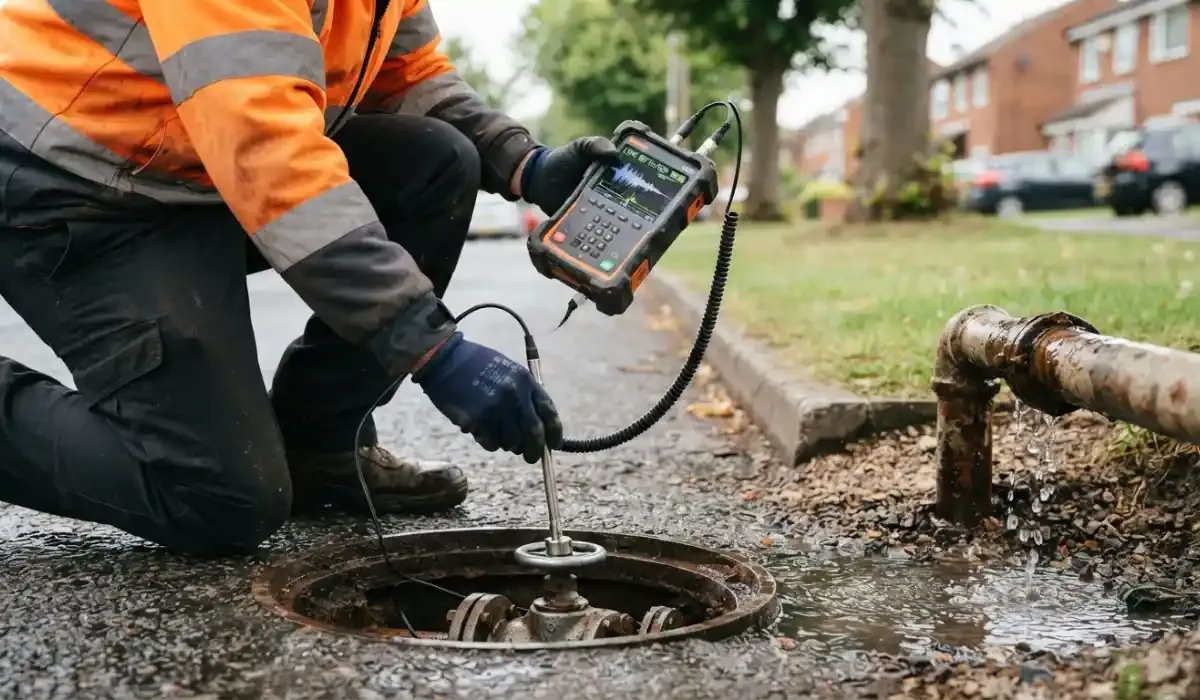
Once the meter test points outside, a technician narrows the search with an electronic leak locator, listening gear and a pressure gauge. These tools hear the leak and pinpoint it on the surface. Our leak detection visits aim to mark the spot so the dig is a small one and not a trench across your lawn.
If the damaged pipe is the line between the street and the house, the repair is a service-line job. Our water service line repair work covers that stretch, and who hires whom depends on where the break sits.
Bloomfield, CT: who owns which stretch of pipe
In MDC territory, the water ordinance says the MDC repairs old service pipes that break between the main and the street line at no charge to the owner. The owner pays for service from the street line to the building, through a licensed installer. That means a break in the yard is yours to fix, while a break at the curb may not be.
The same ordinance bills the owner for all water that passes through the meter, whether it is used or wasted. A buried leak therefore shows up on your bill. The MDC's leaks page does not describe bill adjustments, and we found no policy for them, so ask the MDC directly.
Only the MDC, approved government crews or State-licensed persons may install or alter water services. If someone offers to dig up your service pipe, ask for proof of licensing.
Neighboring towns, different utilities
Homes in West Hartford draw from the MDC like Bloomfield does, so the ownership split above is a fair starting point there. Homes in Simsbury are different. The town does not supply water, and Aquarion serves most addresses, with Connecticut Water and the Tariffville Water Commission covering parts. Call your own provider first.
Wherever you live, Call (860) 397-8103 if the meter keeps moving after the house main is closed.
Underground leak questions
Compare the bill with the same season in earlier years, then run the meter test. If the meter moves with every fixture off, water is leaving the system. The MDC pages we reviewed do not describe a leak indicator, so ask the MDC which dial to watch.
The MDC water ordinance says the owner pays for service from the street line to the building, through a licensed installer. The MDC repairs old service pipes that break between the main and the street line. Call the MDC to confirm which side your break is on.
We found no adjustment policy in the MDC ordinance or on its leaks page. The ordinance bills the owner for water through the meter whether used or wasted. Ask MDC customer service whether anything applies to your account.
Yes. Our line runs 24/7. Close the house main, call 811 before any digging, and call the MDC Command Center at 860-278-7850, press 1, if water is flowing in the street.
A buried service line, a sprinkler leak or a broken drain can all do this. Run the meter test. If the meter stays still with the main closed, the cause is probably not the water service.
The MDC says toilets account for about 95 percent of leaks and exterior leaks for about 4.5 percent. The remaining half percent covers leaks past the meter pit and buried piping, so a buried leak is uncommon but costly.