
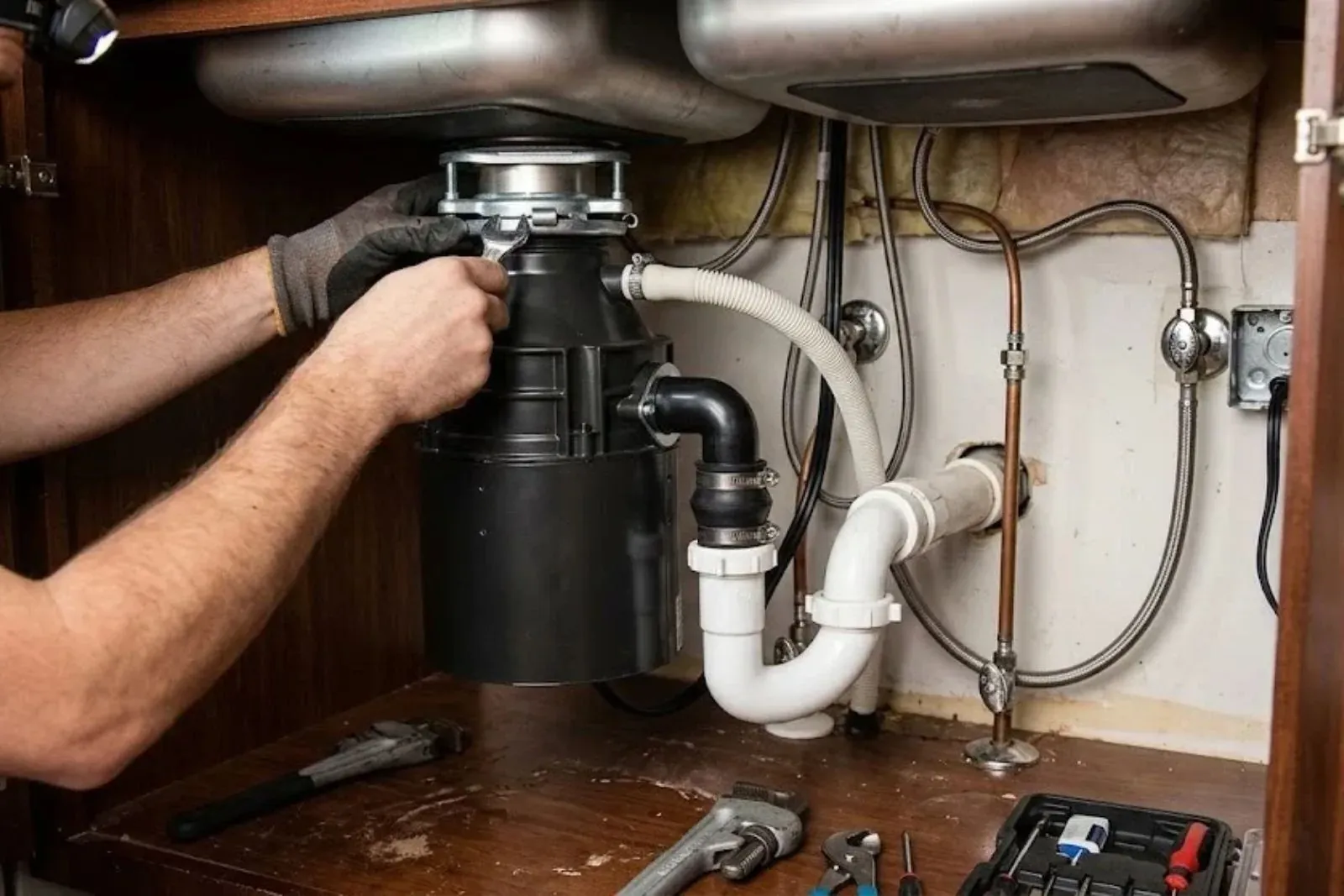
What the job involves, from flange to switch
A disposal hangs from the sink drain opening on a mounting ring. The old strainer comes out, a new flange seats in plumber's putty or a gasket, and the grinder unit locks onto the mount below the sink. The outlet then ties into the trap arm, and the dishwasher hose attaches to a small inlet on the housing.
Sink flange and mount
The flange must seal to the sink bowl. A cracked or badly pitted bowl opening is better dealt with before the unit goes on.
Drain connection
The disposal outlet needs a clean path into the trap. Old, corroded or misaligned drain pipe often has to be replaced at this point.
Dishwasher inlet
A dishwasher drains through the disposal housing. A sealed knockout plug inside the inlet must be punched out or the dishwasher will not empty.
Power
The unit needs a switched supply under the sink. Some models arrive with a power cord, and others are wired directly into a box.
Choosing a unit that fits your sink and your habits
Most households choose between a continuous-feed disposal and a batch-feed model. Continuous-feed runs while a wall switch is on, and batch-feed runs only when a stopper lid is twisted into place. Motor size matters too. Larger motors grind finer and jam less often, though they weigh more and need a solid mount.
| Choice | Good fit | Watch for |
|---|---|---|
| Continuous-feed | Busy kitchens that scrape plates throughout the evening | Dropped spoons and bottle caps can reach the grinder while it runs |
| Batch-feed | Homes with small children or tight sink bowls | The stopper lid and its magnet or lever add moving parts |
| Larger motor | Households that cook from scratch most nights | Heavier unit needs a firm mount and enough cabinet height |
| Corded model | Sinks with a switched outlet already under the counter | The outlet must sit where the cord can reach without strain |
| Hardwired model | Sinks with a junction box and a wall switch | The connection counts as electrical work, so ask who handles it |
How a plumber installs one, step by step
Cut power and clear the cabinet
The breaker goes off first, then the cabinet gets emptied. A dead tester at the wires confirms the circuit is truly off before anyone reaches under the sink.
Remove the old drain parts
The old disposal or the basket strainer comes out, along with the putty ring and any worn slip nuts. The sink opening is cleaned down to bare metal or porcelain.
Mount the new unit
The flange is set, the mounting ring is tightened evenly, and the grinder is lifted into place and locked. Uneven tightening is a common reason for slow weeping at the flange.
Connect drain, dishwasher and power, then test
The outlet is aligned to the trap, the dishwasher hose is clamped on, and the power is connected. Water runs for several minutes while someone checks every joint with a dry paper towel.
What you can do yourself, and where to stop
Plenty of homeowners replace an old disposal with a similar one, and that swap is realistic with basic hand tools. The trouble starts when the job grows. New drain pipe, a new outlet or a switch that does not exist yet turns a quick swap into a plumbing and electrical project.
Call a plumber if you see any of these
Stop the project and get help when the sink shows one of these signs.
- The existing drain pipe is corroded, wobbly or leaking at the wall.
- There is no switched power under the sink and the wiring would be new.
- The sink bowl has a crack or soft spot around the drain opening.
- The dishwasher hose is brittle or the connection has already leaked.
- Water stands in the sink bowl because the line below is slow or blocked.
- You are not sure the breaker feeding the sink is the one you switched off.
Power, licensing and permit questions
Connecticut's plumbing statute (CGS 20-330) defines plumbing work around water and gas systems, fixtures and piping, and it defines electrical work separately. Garbage disposals are not named in either definition. A disposal therefore sits between the two trades, and the state pages we checked do not say who may make the final wiring connection. Ask any installer who is handling it.
Bloomfield's Building Division keeps a list of permit-exempt work. Repairing a leak or clearing a clog is exempt when no pipes, valves or fixtures are replaced or rearranged. The list does not mention disposals, so call the Building Division at 860-769-3516 before you start. Altering supply or drain piping does need a plumbing permit, and that is the part that matters if the drain has to change.
According to the CT Department of Consumer Protection, electrical work is licensed separately as E-1 and E-2 under CGS 20-330, so ask who is handling the disposal's power connection.
Old disposal leaking under the sink right now?
Shut the water at the sink valves, empty the cabinet and switch off the breaker. Our 24/7 line is open if water is spreading, and we offer same-day appointments when available.
What shapes the cost of an install
Quotes for the same sink vary because the work underneath varies. A straight swap at a sink with working power and sound drain pipe is the simple end. Our plumbing installation visits start with a look under the cabinet, and you get a clear price before work starts.
- The unit itself: motor size, sound insulation and stainless or plastic grinding parts.
- Drain condition: a corroded trap arm or mismatched pipe adds parts and labor.
- Power: an existing switched outlet costs less than running new wiring.
- Dishwasher hookup: a new hose, air gap or high loop can add steps.
- Access: a crowded cabinet with a water filter or soap dispenser slows the work.
Your homeowners policy may or may not respond to a disposal that fails from age. Ask your insurer, because policies usually cover sudden and accidental damage and not wear.
Bloomfield, CT: what MDC customers should know
Bloomfield is one of eight Metropolitan District Commission (MDC) member towns, and the MDC runs the wastewater system. Its sewer ordinance bars unground or unshredded garbage from public sewers. A disposal that grinds properly is the point, so a unit that jams or leaves chunks is working against that rule.
The MDC's household guidance on fats, oils and grease says not to pour cooking oil or fat down the sink. It suggests wiping greasy pans with a paper towel and putting small amounts in the trash. A disposal does not change that advice, so scrape the pan before you rinse it.
If your home is on a septic system and not on MDC sewer, the EPA says a disposal adds solids and the tank will need pumping more often. We found no record of how many Bloomfield homes use septic. The West Hartford-Bloomfield Health District can tell you which system serves your address.
Habits that keep a new disposal running
- Run cold water before, during and for a short time after each use.
- Feed scraps in small handfuls and not in one heavy load.
- Keep grease and oil out, following the MDC guidance above.
- Skip stringy peels, celery stalks and large bones that wrap or jam the shredder.
- Never put your hand into the opening. Use tongs for dropped items after the breaker is off.
When the problem is the old unit, not the install
Some disposals only need service. A hum with no spin is often a jam that clears with a hex key at the base, and a loose drain joint can be tightened. A leak from the body seam is different, since the housing cannot be patched. Our garbage disposal repair page covers which faults are fixable and which call for a new unit.
Neighbors in West Hartford and Windsor face the same decisions. Both towns are MDC member communities, so the grease and garbage rules above apply there as well.
If you would rather have the sink, drain and power checked in one visit, Call (860) 397-8103 and describe what is under your cabinet.
Garbage disposal installation questions
Bloomfield's permit-exempt list covers leak repairs and clog clearing when pipes, valves and fixtures are not replaced or rearranged. It does not name garbage disposals. Call the Building Division at 860-769-3516 before you start, especially if the drain piping will change.
It depends on the sink. A corded unit plugged into a working switched outlet needs no new wiring. A hardwired unit or a missing switch involves electrical work, which Connecticut defines separately from plumbing. Ask your installer who handles that part.
No. The MDC asks residents not to pour cooking oil or fat down the sink. Wipe pans with a paper towel and put small amounts in the trash.
The EPA says disposals add solids, so a septic tank needs pumping more often. Limit use and ask the West Hartford-Bloomfield Health District about your system.
The knockout plug inside the dishwasher inlet was probably left in place. It has to be removed with a screwdriver, with the plug fished out of the housing.
Yes, in most cases. We check the trap, the wall stub and the sink opening first, then give you a clear price before work starts.