
Gas smell? Leave first
If you smell gas near a water heater, leave the building right away. Call the gas utility or 911 from outside, and only then call a plumber. Do not flip switches, use a lighter or start the vehicle in an attached garage.
The same applies if a CO alarm sounds. Get everyone outside into fresh air and call 911.
What the vent pipe actually does
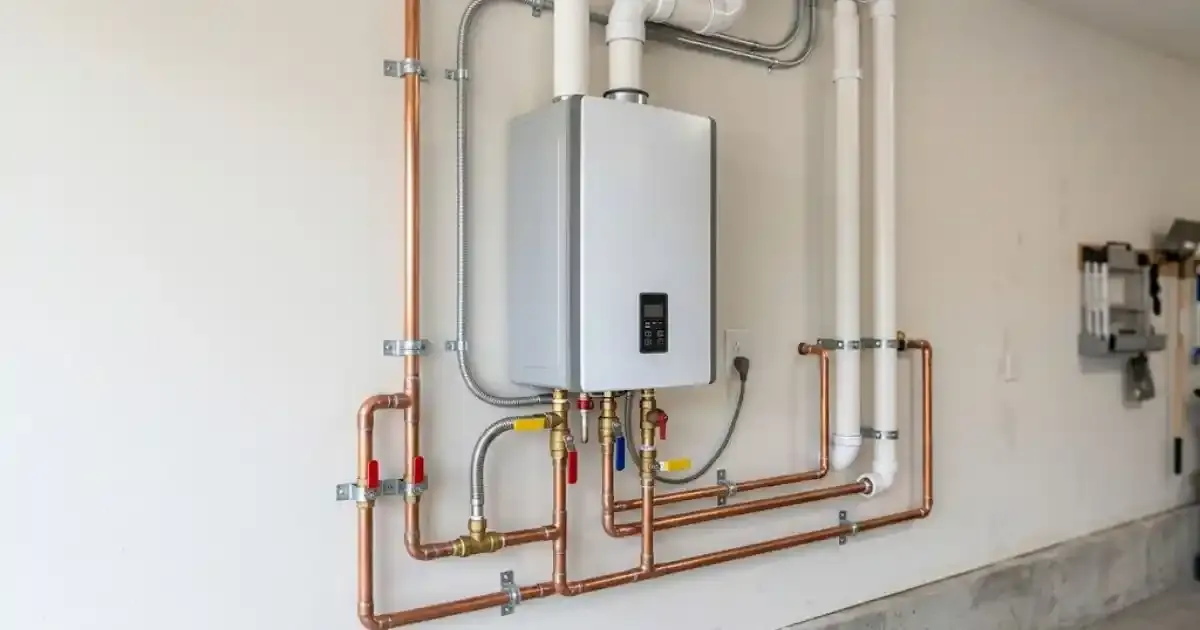
A gas tankless heater burns fuel to heat water as it flows. That burning makes exhaust, and the vent pipe moves it from the unit to the outdoors. If the exhaust leaks back into the home, carbon monoxide can build up in rooms where people are sleeping.
Tankless units burn hotter and more intensely than a tank heater's burner, and they are built tighter. That is why the vent is engineered with the heater instead of treated as an afterthought. When we install a tankless water heater, the vent plan is part of the first site visit, not the last.
Condensing and non-condensing units
Tankless gas heaters fall into two broad groups. A non-condensing unit sends hot exhaust up the vent. A condensing unit pulls more heat out of the exhaust, so the gases leave cooler, and water vapor in them turns to liquid inside the vent.
That liquid condensate is mildly acidic, and it can corrode the wrong metal. A condensing unit therefore uses a vent material made to resist it, and it needs a slight downward slope so condensate runs back to a drain. A non-condensing unit has different demands, usually hotter exhaust, which is why its vent material and clearances differ.
| Feature | Non-condensing | Condensing |
|---|---|---|
| Exhaust temperature | Hot | Cooler |
| Condensate in the vent | Little or none | Yes, drains back to the unit |
| Typical vent materials | As listed by the maker, often stainless steel | As listed by the maker, often stainless steel or approved plastic |
| Condensate drain | Usually not needed | Needed, and may need a neutralizer |
| Slope of horizontal runs | Per the manual | Slopes back toward the unit |
| Where to find the rule | Installation manual | Installation manual |
We keep the table general on purpose. Vent categories and approved materials vary by model, and we could not verify a single universal rule from a primary source. The installation manual for your unit is the authority.
Why the material matters
Stainless steel
Handles heat and resists acidic condensate. Many manufacturers list it for one or more of their models, usually in a specific grade and as a purpose-made vent system.
Approved plastic
Some condensing models list plastic vent pipe because the exhaust is cooler. Only the types the manufacturer names are allowed.
Galvanized or single-wall chimney pipe
Not an automatic substitute. Zinc coatings and thin walls can corrode quickly, and the listing may not allow them.
Mixed parts
Using one maker's pipe on another maker's heater can break the listing. Keep the vent parts from the system the manual names.
Ordinary steel or aluminum duct is not vent pipe at all. It can melt, rust through or leak at the seams. The manufacturer's listing covers the heater and its vent parts as a tested system, and a wrong part voids that listing and may void the warranty.
What a safe vent installation involves
Read the manual for the exact model
It states the allowed vent material, diameter, maximum length, number of elbows and clearances to windows and combustibles.
Choose the route
The shortest straight route usually works best. Every elbow reduces the allowed length.
Assemble and seal per the maker
Each joint is joined and sealed the way the manual specifies, with supports at the spacing it lists.
Test and inspect
A plumber checks combustion, leaks at each joint and condensate flow, then the Building Division inspects the work.
Our water heater installation visits include checking the vent route before the old heater comes out. A tankless swap sometimes needs a new vent route, a new gas line size or a wall penetration, and these are all decided up front. According to DOE guidelines, a tankless installation depends on fuel, climate and code, and it recommends a licensed plumbing or heating contractor plus a permit check with the Building Division.
Not sure your vent is right?
If your tankless heater has a discolored vent, a white crust on joints, or a sagging pipe, call us on the 24/7 line. Turn the unit off and open a window if you can do so safely. Same-day appointments are available when the schedule allows.
Warning signs on an existing vent
Vent warning signs
Any of these means turn the heater off at its control and call a plumber.
- Soot, scorching or brown staining around the vent or the unit.
- A CO alarm that sounds or a headache and nausea that clears when you leave the house.
- Water dripping from vent joints or pooled under a condensing unit.
- White or green crust at vent joints.
- Vent sections that sag, have separated or rattle in the wind.
- A heater that shuts off repeatedly with an error code.
Connecticut's Department of Public Health advises annual inspection of heating systems, flues and gas appliances. It also says to keep carbon monoxide alarms on every level and near sleeping areas, and to replace the units every 7 to 10 years. A new tankless install is a good time to check every alarm's date.
Bloomfield, CT: permits and rules for gas venting
Bloomfield enforces the 2022 Connecticut State Building Code, which names the 2021 International Mechanical Code. The state page we checked did not list the fuel gas code edition, so we do not quote a vent rule from it. For you, the practical rule is to follow the manufacturer's manual and ask the Building Division at 860-769-3516 how it handles the permit.
The Department of Energy also notes that tankless installation depends on fuel, climate and code, and it recommends a licensed contractor and a permit check. Changing a gas line or vent in a Bloomfield home generally means a conversation with the Building Division before work begins.
What shapes the cost of tankless venting
Venting is often the part of a tankless job that changes the quote most.
Ask your insurer about coverage for appliance failure. Typical homeowners policies cover sudden and accidental damage, not wear or gradual corrosion.
Call (860) 397-8103 and we will explain the vent plan and give a clear price before work starts.
What a homeowner can do and when to call
- Do check CO alarm dates and test them monthly.
- Do keep the area around the vent and air intake clear of storage and snow.
- Do keep the installation manual with the heater.
- Do not cut, tape or reroute vent pipe yourself.
- Do not replace stainless vent with a hardware store substitute.
- Call a plumber for any vent change, noise, discoloration or error code.
We handle tankless jobs for homes in Windsor and West Hartford as well as Bloomfield. The vent plan follows the same rule everywhere: the manual for your unit decides, and the plumber installs to it.
Tankless vent pipe questions
Not always. Some models call for stainless steel and others for approved plastic. The installation manual for your exact model lists the allowed material, and you should follow it.
Usually not. Tankless units often need a different material, diameter or route than a tank heater. Check the manual and have a plumber confirm before you reuse any part.
A condensing unit pulls more heat from the exhaust, so the gases are cooler and form liquid condensate in the vent. That calls for corrosion-resistant vent material and a drain. A non-condensing unit exhausts hotter gas.
Warning signs include soot, white crust, dripping joints and a CO alarm going off. If you notice any, turn the heater off and call a plumber. If an alarm sounds, go outside and call 911.
Call the Bloomfield Building Division at 860-769-3516. It enforces the 2022 Connecticut State Building Code and inspects plumbing and mechanical work. Ask whether your gas line or vent change needs a permit before work starts.
Leave the building at once. Call your gas utility or 911 from outside, and call a plumber only after the utility says it is safe. Do not use switches or flames.