
The short answer, then the reasons
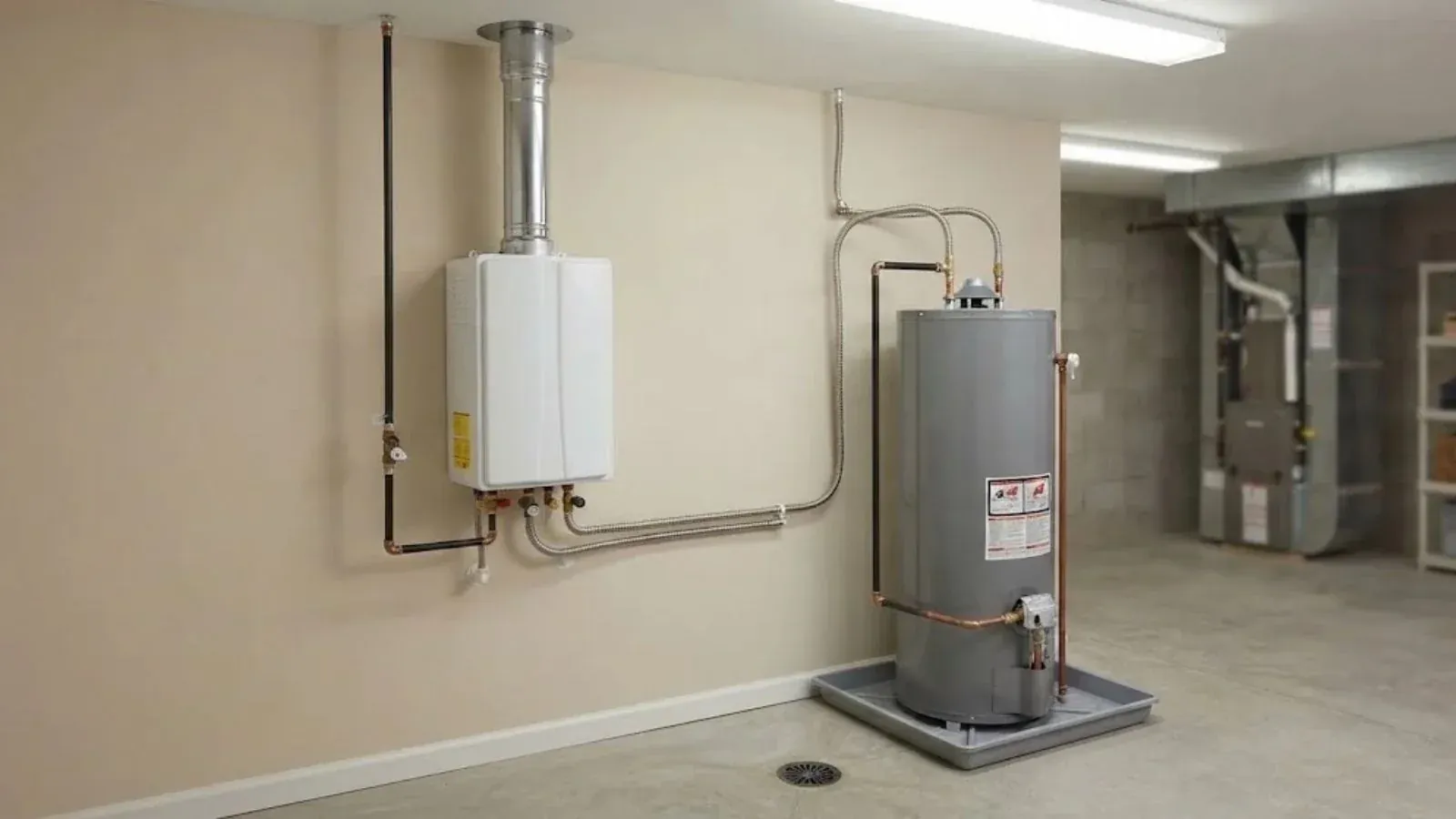
A tank heater keeps a stored supply of hot water ready and reheats it as it cools. A tankless heater, also called on-demand, heats water only when a tap opens. That difference drives every other trade-off in this guide.
The U.S. Department of Energy says a tankless heater typically lasts more than 20 years, against 10 to 15 for a storage tank. It also says tankless units save the most energy in homes with low hot water use. For a household using about 41 gallons a day or less, a tankless model can be roughly 24 to 34 percent more efficient than a storage tank.
Efficiency depends on how much hot water you use
Standing losses are the heat a tank gives up while it sits waiting. A tankless heater has none. That is why light users gain the most.
As use climbs, the gap shrinks. DOE puts the saving at roughly 8 to 14 percent for a home using about 86 gallons a day. Its work on gas tankless heaters adds that the savings are smaller on very small draws and peak near 50 gallons a day. A big family with long showers and a dishwasher running at the same time sees a narrower gain than a couple living alone.
| Factor | Tank | Tankless |
|---|---|---|
| Typical life | 10 to 15 years | More than 20 years (DOE) |
| Hot water supply | Limited by tank size, then it runs out | Continuous, limited by flow rate |
| Efficiency in a light-use home | Loses heat while waiting | Roughly 24 to 34 percent better (DOE) |
| Efficiency in a heavy-use home | Closer to tankless | Roughly 8 to 14 percent better (DOE) |
| Install complexity | Usually simpler | May need gas line, vent or electrical upgrades |
| Space | Needs floor space for the tank | Wall mounted, small footprint |
Who tends to prefer a tank
Tight budgets and quick swaps
A tank usually goes into the same spot as the old one with the same connections. That keeps the work shorter and the number lower.
Homes with limited gas or electrical capacity
A tankless gas unit can need a larger gas line than the tank it replaces. An electric tankless unit can need heavy new wiring.
Houses that already have a good chimney or vent
If the existing flue suits a tank, you avoid the cost of new venting.
Homes where space is plentiful
A basement with room for a tank gives up nothing, so the space advantage of tankless matters less.
Who tends to prefer tankless
Small households with modest daily use
This is where the DOE savings figures are highest.
Homes where a failed tank would flood a finished space
No stored water means no tank to burst. Leaks still happen at fittings, but the volume is smaller.
Owners planning to stay many years
A longer expected life helps spread the higher upfront price.
Families that run out of hot water
A tankless heater does not run empty, but it can be overwhelmed if too many fixtures run at once. Size it by flow rate, not by gallons.
Our tankless water heater page explains sizing and what the installation involves. If you want to stay with a tank, water heater replacement covers the standard swap.
The hidden work: gas, vent, electric and water
Tankless units draw a lot of fuel in a short time. A gas model often needs a bigger gas line than a tank. An electric model can need a large dedicated circuit, and the electrical connection falls under Connecticut electrical licensing. Ask who will do that part.
Venting needs care. Each tankless gas model lists the vent material and layout it requires, and installers must follow the manufacturer's instructions. We do not quote vent rules from memory. The right vent depends on the model.
Gas safety and carbon monoxide
Any gas appliance, tank or tankless, deserves these precautions.
- If you smell gas, leave the building and call your gas utility or 911 before you call a plumber.
- Keep carbon monoxide alarms on every level and near sleeping areas.
- Replace alarms on the schedule printed on them, which is 7 to 10 years for many models.
- Have heating systems, flues and gas appliances inspected every year.
- Never run a gas appliance with a loose, blocked or damaged vent.
Those inspection and alarm points come from the Connecticut Department of Public Health. They apply no matter which heater you pick.
What shapes the price of each option
- The unit: a tankless heater costs more than a tank of the same fuel.
- Gas piping: a larger line or new routing adds labor.
- Venting: new flue material and a new route add parts and time.
- Electrical: a heavy circuit for an electric model may need a panel upgrade.
- Water treatment: hard water scale can shorten the life of a tankless heat exchanger, so ask about descaling or a filter.
We do not publish numbers here because the wall, the fuel line and the vent path change every quote. You get a clear price before work starts, with each item listed.
Maintenance you should expect
A tank benefits from an occasional drain to clear sediment and a look at the anode and relief valve. A tankless heater needs periodic flushing to remove scale, and the manufacturer sets the interval. Skipping it is the main way tankless units fail early.
Neither type is maintenance-free. The difference is that a tank failure can flood a room, while a tankless failure usually shows up as lukewarm water or an error code.
Bloomfield, CT: permits and fuel questions
The Bloomfield Building Division inspects plumbing, mechanical and electrical work and enforces the 2022 Connecticut State Building Code. A tankless conversion often changes gas piping, venting or wiring, so confirm the permit steps with the office at 860-769-3516 before work begins.
The town's exempt-work list does not mention water heaters, so do not assume a swap is exempt. Plumbing work needs its own trade permit application, and the town asks for 48 hours of notice to schedule inspections.
Federal data from 2020 shows Connecticut homes split among fuel oil or kerosene at about 39 percent, natural gas at about 36 percent, electricity at about 19 percent and propane at about 4 percent. Your fuel narrows the choice. An oil-fired home cannot simply switch to a gas tankless unit without a new gas service.
Homeowners in Windsor and Hartford weigh the same trade-offs, and our team covers both towns.
Tankless vs tank questions
No. The Department of Energy puts the gain at roughly 24 to 34 percent for light users and 8 to 14 percent for households using about 86 gallons a day. Heavy users see a smaller gain, so look at your own use before deciding.
It never empties like a tank, but it can only heat so much water per minute. If several showers and a dishwasher run together, flow can drop. Sizing the unit to your peak demand prevents that.
DOE lists more than 20 years for tankless and 10 to 15 years for storage tanks. Real life depends on water quality, maintenance and installation. Hard water scale is a common cause of early tankless problems.
Only if gas service reaches your home or can be brought in, and gas piping and venting change require permit checks with the Building Division. Many Connecticut homes heat with oil, so confirm gas availability before planning.
Likely yes if the job changes gas, vent or electrical connections. The town's exempt list covers leak repairs without replacing pipes or fixtures and does not name water heaters. Call 860-769-3516 to confirm.
A like-for-like tank swap is the simpler choice if you will move within a few years, since you will not recover a tankless premium. Owners who plan to stay long term get more from the longer life.