
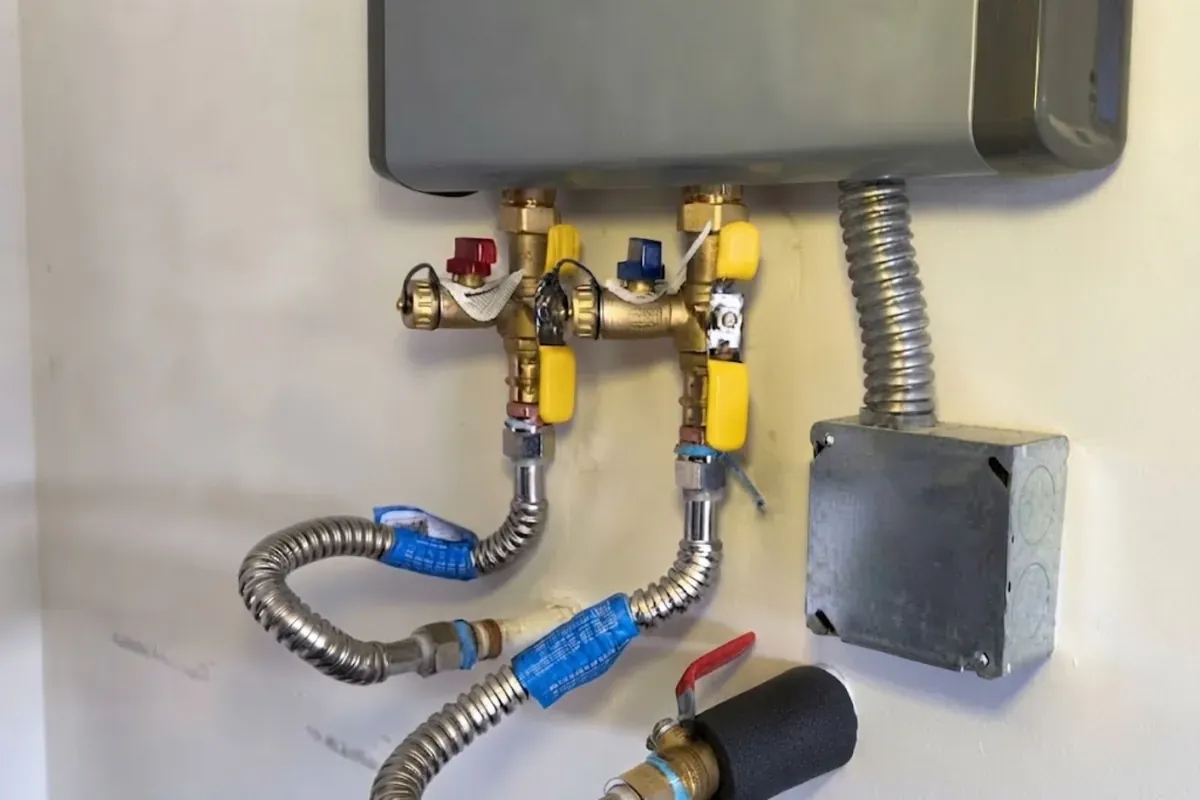
Why electric tankless wiring is a bigger job than it looks
A tank heater warms water slowly over hours. An electric tankless unit has to heat water as it flows, so it pulls a large amount of power the moment a tap opens. That demand is why the wiring is the part of the job that surprises most homeowners.
The heater cannot share a circuit with lights, outlets or other appliances. It needs its own run of cable from the panel, a breaker matched to the unit, and in many homes a spare space in the panel to hold that breaker. Some houses need the panel itself upgraded before the heater can go in.
Our tankless water heater work starts with this question, because the electrical side often decides whether a tankless unit makes sense at all.
The parts of an electric tankless circuit
| Part | What it does | Who decides the size |
|---|---|---|
| Dedicated circuit | A cable run only for the heater, from the panel to the unit | The manufacturer's installation manual |
| Breaker | Protects the cable and heater from overload | The manual, matched to the unit and the cable |
| Wire size and type | Carries the load without overheating | The manual and the electrical code |
| Panel capacity | Must have room for the extra load and the breaker | A licensed electrician checks it |
| Disconnect and connection at the unit | Lets the heater be switched off for service | The manual and the code |
| Grounding | Gives fault current a safe path | The manual and the code |
We do not print amperage or breaker numbers here on purpose. They differ by model, and the only correct figures are the ones in the manual for the exact unit you buy. The U.S. Department of Energy says to follow the manufacturer's manual and to use a licensed contractor with a permit and code check.
Check these things before you pick a unit
Electrical readiness checklist
Gather this before you shop, and a plumber and electrician can answer faster.
- Open the panel door and note the brand and whether any breaker spaces are free.
- Look at the panel label for its total rating and ask an electrician if it can carry a new large load.
- Find the best mounting wall and measure the distance to the panel, since long runs need more cable.
- Check what the current water heater runs on, gas or electric, because switching fuels changes the work.
- Read the installation manual for any model you are considering before you buy.
- Ask whether your home has had panel work before and whether permits were closed.
Who does what: plumber, electrician, inspector
Connecticut law defines plumbing work and electrical work separately. Plumbing and piping work covers the water systems, fixtures and piping. Electrical work covers wire, cable, conduit and equipment that uses electrical energy. The state licenses them as different trades, with electrical contractors and journeypersons holding E-1 and E-2 licenses.
We could not confirm from the state's pages whether a plumbing license allows the final power connection. So the safe approach for a homeowner is to ask your installer directly who is licensed to make the electrical connection, and to get that answer in writing before work starts.
Plan the job on paper
A plumber confirms the water side, the location and the model. An electrician confirms the panel can carry the load.
Rough-in the circuit
The licensed electrician runs the dedicated cable from the panel to the unit's location and sets the breaker.
Mount the unit and connect water
The plumber mounts the heater, connects the hot and cold lines, adds shutoff valves and fills the unit with water.
Power on after the tank is full
The heater is energized only after water flows through it. Then both trades go through inspection.
Our water heater installation team coordinates the plumbing side and works with the electrical trade so the order of steps is right. The key point for you is that water must be in the heating elements before power is switched on.
Why a DIY wiring attempt is a bad idea
A tankless heater draws far more current than a typical household appliance. An undersized cable, a wrong breaker or a loose connection can overheat inside a wall. That is a fire risk, and it may also void the manufacturer's warranty and complicate a future insurance claim.
- Wrong wire size is the most common cause of overheating cable runs.
- A breaker that is too large lets the cable burn before it trips.
- A loose terminal at the unit creates heat that you cannot see.
- Skipping the permit can cause trouble when you sell the house.
- Powering the unit before it is full of water can destroy the heating elements.
Planning a tankless switch?
Tell us what you have now and we will help you work out the plumbing and electrical order of steps. Call Call (860) 397-8103 and we can set up a visit, with same-day appointments when available.
Permits and inspections in Bloomfield
Connecticut enforces the state building code, and the Bloomfield Building Division inspects building, electrical, plumbing and mechanical work. The code currently in effect uses the 2021 International Plumbing Code (IPC) and the 2020 National Electrical Code.
The Building Division says plumbing work needs its own trade permit application, separate from the building permit. Most permits are issued about 10 days after plans are submitted, and inspections are scheduled 48 hours ahead. The page does not say whether homeowners may pull their own permits, so ask the Building Division at 860-769-3516.
Bloomfield, CT: what to ask about permits
In Bloomfield, an electric tankless job touches both the plumbing and the electrical permits, since a new circuit is electrical work and the water connections are plumbing work. Ask your contractor which trade is pulling each permit, and who will be on site for each inspection.
The Building Division works from Town Hall at 800 Bloomfield Avenue and takes inspection appointments at 860-769-3516. Because permits take about 10 days and inspections need 48 hours of notice, build that lead time into your plan, especially if your current water heater is failing.
What drives the cost of an electric tankless install
The unit is only part of the bill. These factors change the final price.
Ask your insurer how it treats permitted versus unpermitted work. Typical homeowners policies cover sudden and accidental damage, not wear or faulty work.
Call (860) 397-8103 for a clear price before work starts.
When electric tankless is the wrong fit
Electric tankless units suit homes with the panel capacity for them and with modest hot water use. The Department of Energy reports that homes using 41 gallons a day or less can see tankless run about 24 to 34 percent more efficient than a storage heater, while at about 86 gallons a day the gain shrinks to about 8 to 14 percent.
That means a large family with back-to-back showers will see less savings. In that case a gas tankless, a heat pump unit or a new tank may beat an electric tankless on both cost and wiring work. A plumber can walk through the options during a site visit.
If you live near us in Simsbury or Hartford, the same electrical readiness questions apply. Each town has its own building office, so confirm the permit steps with the local one.
Tankless wiring questions
Yes, in nearly every case. The manufacturer's installation manual gives the circuit and breaker requirements for the exact model, and a licensed electrician sizes the wiring to match.
We advise against it. Connecticut treats wiring as electrical work with its own license category, and a wrong cable size or breaker can create a fire hazard. Hire a licensed electrician and have the work permitted.
Possibly. Tankless units draw a large load, so older or full panels sometimes need upgrading. A licensed electrician can check the panel rating and free space before you buy a unit.
The heating elements can burn out if they run dry. Water must flow through the unit and air must be purged before the breaker is switched on.
Call the Bloomfield Building Division at 860-769-3516. Plumbing and electrical work each need review, and the Division says inspections are scheduled 48 hours ahead and most permits issue about 10 days after plans are submitted.
Gas tankless heaters usually need a small power supply for controls and fans. The manufacturer's manual lists it, and the same rule applies: a licensed electrician handles the circuit and a plumber handles gas and water.